




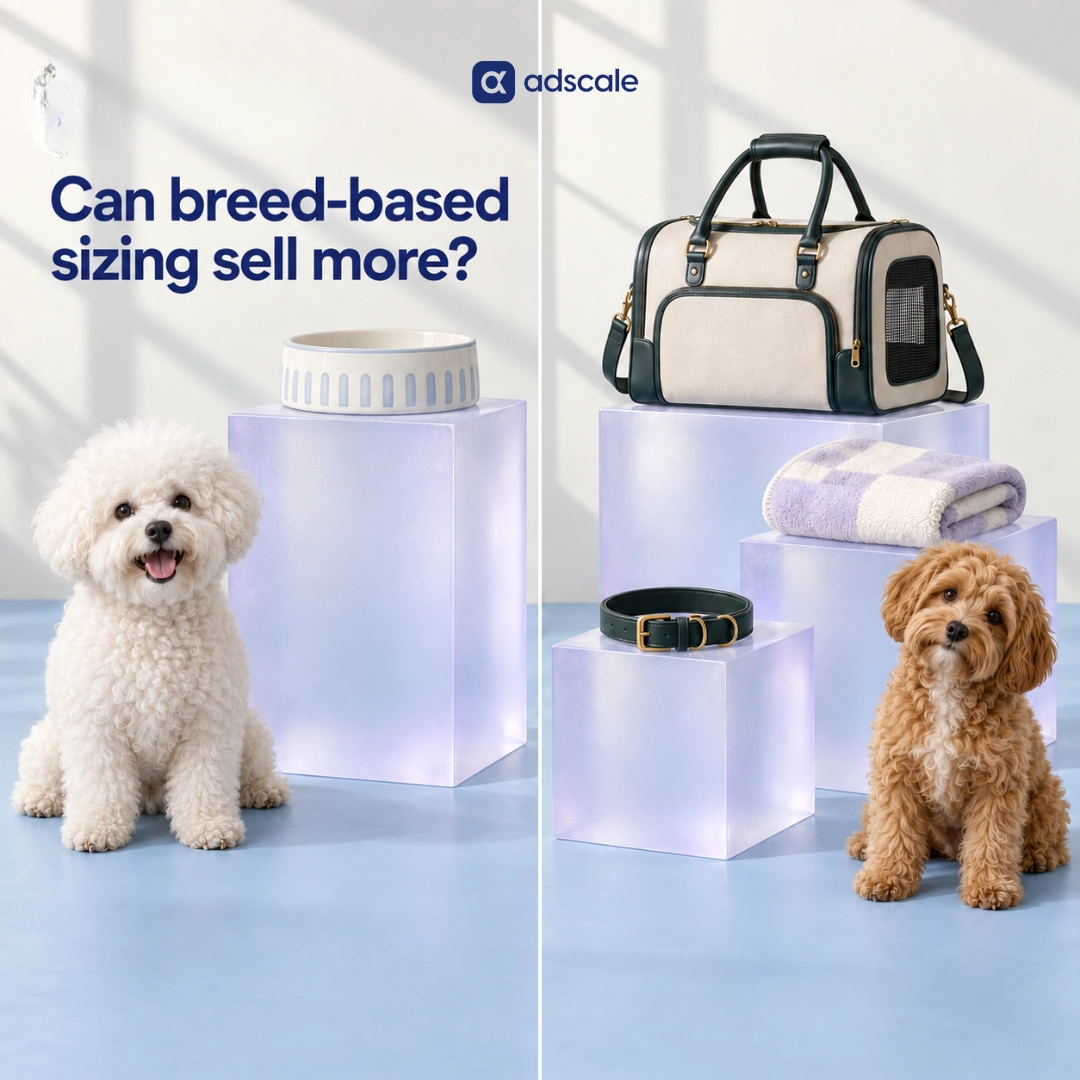


Your shopper recognizes their dog. Your size guide should help them recognize the right fit.
A French Bulldog owner and a Border Collie owner open the same harness page. Both pause at “Medium”. One pictures a compact, barrel-chested dog. The other pictures a lean, athletic dog. The label gives neither much help.
Breed-based size guides may help shoppers choose more confidently. Pair familiar breed examples with clear measurements, then check whether more customers buy the right size and keep it. The research reviewed here does not establish a specific conversion lift from breed labels.
There is, however, a strong reason to investigate fit. In Galaxus’s 2025 Swiss data, pet supplies had a 1.2% return rate. Dog clothing reached 11%, roughly nine times higher. Sizing accounted for 80% of dog-clothing returns. These are one retailer’s results, reported by GlobalPETS and available in a published reproduction.
A healthy category average can hide a costly problem in the products that have to fit.
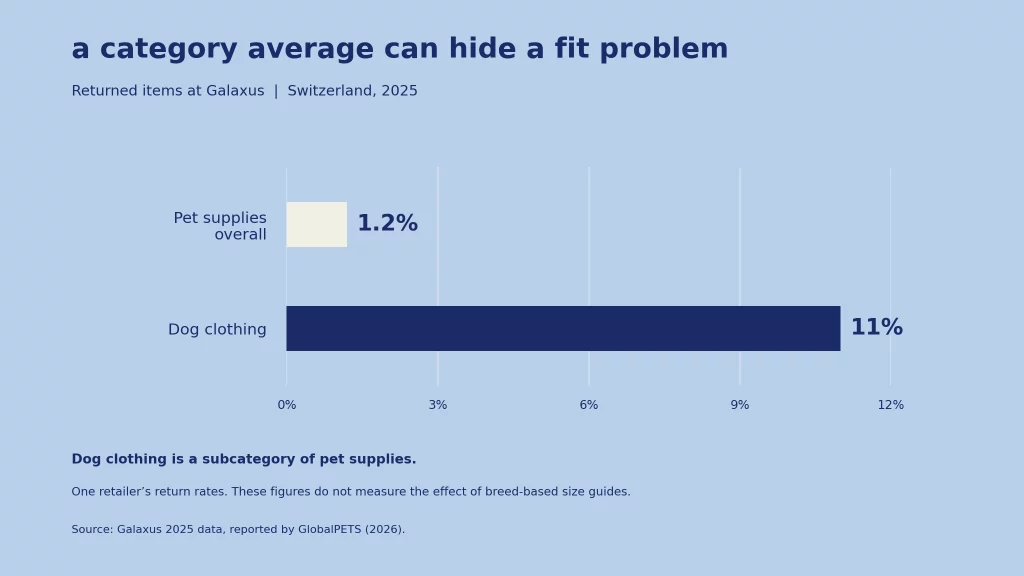
Return rates for Galaxus in Switzerland, 2025. Source: GlobalPETS reporting, linked above. The clothing figure describes a subcategory within pet supplies.
Key takeaways
- Examine harnesses, coats, and other fitted products separately from the rest of your catalog.
- Use breed examples to make measurements easier to interpret, with an equally clear route for mixed-breed owners.
- Build recommendations from the actual product and customer fit evidence.
- Measure purchases, wrong-fit returns, and the money left after those returns.
Why can a size label cost a pet store sales?
The ad earned the click. The shopper likes the product. Now a small dropdown has to answer a much bigger question: “Will this work for my dog?”
If the chart is hidden, the measurements are unexplained, or the only photo shows a completely different body type, the shopper has to fill in the gaps. They might ask support, order two sizes, guess, or leave.
That is the ambiguity tax: the potential cost of unclear fit information before and after checkout. Returns reveal the orders that went wrong. They miss the people who never felt confident enough to order.
This is also where the promise in your advertising meets the product page. If an ad presents a harness for broad-chested dogs, the page should explain how that design fits them. AdScale’s guidance on connecting ads and landing pages addresses that same need for a consistent buying journey.
The useful question is where the shopper becomes uncertain, and what information would resolve it.
What benchmarks should pet merchants use?
Alongside the returns data, two sources provide context for evaluating conversion and sizing:
| Benchmark | Reported figure | What it measures |
|---|---|---|
| Pets & Animals conversion | 2.39% | Triple Whale industry reporting, August 2025 to July 2026, within its paid-ad analysis |
| Overall paid-ad conversion | 1.69% | Triple Whale median across its broader dataset for the same period |
| Apparel sites with insufficient sizing information | 83% desktop; 87% mobile | Baymard’s apparel research, published July 2022 |
Sources: Triple Whale’s eCommerce benchmarks and Baymard’s sizing research.
The first two figures help frame performance, but the pet result blends product types. Compare it with similarly measured traffic, then investigate your own wearable products separately. A whole-store conversion rate includes shoppers arriving through other channels and for other reasons.
Baymard’s finding concerns human apparel. Its usability testing also observed shoppers abandoning products when they were unsure about sizing. That makes clearer fit information a reasonable hypothesis for pet wearables, without turning an apparel finding into a measured pet result.
Use benchmarks to locate questions worth asking. Your store’s data should determine what needs changing.
How should breed names work alongside measurements?
S/M/L is a code. A breed name gives the shopper a reference point.
“Labrador” may make a size easier to picture. It cannot tell you whether a particular Labrador fits a particular harness. The dog’s proportions and the product’s cut still matter.
Several retailers make that distinction visible. Euro-Dog groups breeds with neck measurement ranges and asks owners to measure to confirm. Bell & Beau provides typical breed measurements while directing shoppers to each product’s own guide.
Ruffwear emphasizes how to measure for its gear, including using a growing dog’s current measurements. These pages show ways to explain fit; they do not publish conversion results for breed labels.
For a merchant, the practical sequence is simple: recognize a possible fit, measure, confirm. Keep those steps beside the selector, especially on mobile.
Mixed-breed owners should be able to follow the same process without choosing a breed. Where relevant, explain body shapes such as a broad chest or long back, and provide help for measurements that fall between sizes.
How can you improve a pet product size guide?
Start with one popular product that generates repeated fit questions. Four changes can make the page more useful.
1. Find the question customers keep asking
Review recent support conversations, fit reviews, exchanges, and return reasons by product and size. Look for something specific: a coat that fits the chest but is too short, straps that do not adjust enough, or confusion between two sizes.
Use breed-to-size patterns only when customers have supplied that information. An order export usually tells you the purchased size, not the dog’s breed. If the detail is missing, collect it through optional review questions or support follow-ups.
Also separate first-time and returning shoppers. Replacing a familiar harness is a different decision from buying one for the first time. This is a useful application of customer segmentation.
2. Make the measurements easy to use
Check dimensions and adjustment ranges against the actual product. Explain where to measure, provide the units your customers use, and show a simple measurement illustration.
Give product-specific advice for dogs between sizes. A blanket “size up” instruction can create a new fit problem. Keep the chart and help link close enough to use while selecting a size.
3. Add breed examples you can support
Use manufacturer guidance, fit checks, or customer evidence for that item. If a breed spans several sizes, say so. Keep the numeric range prominent and add this short note:
Breed examples are a starting point. Measure your dog and check this product’s size chart before ordering.
Avoid copying the same breed list across every harness, collar, and coat. Each product needs its own fit guidance.
4. Make photos and reviews answer fit questions
Caption real product photos with the dog’s breed or mix, relevant measurements, and size worn when those details are available. Ask reviewers for the same information and whether the fit worked.
Include useful reports of awkward fits as well as successful ones. A shopper whose dog has unusual proportions may learn more from an honest explanation of a poor fit than from another five-star review saying “great quality.”
How can you test whether the change works?
Run a comparison on the same product pages, randomly assigning shoppers to a consistent experience:
- Control: size labels, complete measurements, and measurement instructions.
- Variant: the same content, with validated breed or body-shape examples added.
Keep prices, promotions, photos, and available sizes consistent. If you change photos and reviews too, evaluate the whole sizing update; you will not know the effect of the breed cue alone.
Before launch, agree on a conversion definition, the smallest improvement worth detecting, and the required sample. AdScale’s introduction to A/B testing explains the basic comparison and why changing settings mid-test undermines it.
Focus the decision on three outcomes:
- Purchases: Do more exposed shoppers buy the tested products?
- Fit: Do wrong-fit returns and size exchanges improve?
- Economics: Does contribution after returns increase per exposed shopper?
For the third measure, account for discounts, refunds, product costs, fulfillment, return handling, and stock that cannot be resold. Add-to-cart behavior and orders containing multiple sizes can help explain the result.
Reach the planned sample, then allow both groups’ final orders to complete delivery and the return window. A week might be enough to prepare the experiment. It does not automatically provide enough evidence to judge it.
With limited traffic, use customer feedback to fix clear problems and treat sales changes as directional findings.
What could a small conversion improvement mean?
Here is a hypothetical calculation, using equal traffic and an unchanged average order value:
| Metric | Baseline | Example result |
|---|---|---|
| Eligible product-page sessions | 20,000 | 20,000 |
| Purchase conversion | 2.0% | 2.2% |
| Orders | 400 | 440 |
| Average order value | $60 | $60 |
| Revenue before returns | $24,000 | $26,400 |
That change is a 10% relative improvement, or 0.2 percentage points. It produces 40 additional orders and $2,400 in additional revenue before returns. It illustrates how to value an observed result, rather than predicting what breed cues will deliver.
Then follow the orders. If more shoppers buy the wrong size, the revenue increase can overstate the benefit. If conversion stays flat but exchanges and returns fall, the update may still be worthwhile.
A faster purchase is valuable when the fit holds up after delivery.
Frequently asked questions
They may make sizing easier to interpret, but the research reviewed here does not isolate a conversion lift from breed labels. Test accurate breed references alongside product measurements, and evaluate purchases together with wrong-fit returns. The benefit depends on whether the guidance resolves a real customer problem.
Triple Whale reports 2.39% for Pets & Animals in its August 2025 to July 2026 industry table, within paid-ad reporting. Use it as context, then compare your own results using consistent channel, product, device, and customer definitions. It is not a universal store target. Source.
No. Breed names provide a reference point; the product’s measurements and adjustment range guide the size choice. Individual dogs vary, and products fit differently. Keep the chart visible, explain how to measure, and offer a clear route for mixed breeds and dogs between sizes.
Divide units returned for incorrect fit by fulfilled units of the tested products, using orders with completed return windows. Track size exchanges separately. This measures how often purchases lead to fit returns. The share of returns caused by fit answers a different question about return reasons.
Run it until the planned sample is reached and both groups’ orders have completed delivery and the return window. Duration depends on traffic and the improvement you want to detect. Avoid judging success from an early conversion increase while exchanges and returns are still arriving.
Make the right size easier to keep
The French Bulldog owner and the Border Collie owner already want to know whether your harness is right for their dogs. Help them answer that question with a familiar reference, clear measurements, and evidence of how the product fits.
Start with the item that generates the most fit questions. Improve the guidance and follow the results through delivery and returns.
Make the right size easier to recognize, easier to check, and easier to keep.
Keep reading
- Ads That Convert: Connecting Ads and Landing Pages: Keep the promise in your advertising consistent with the page shoppers reach.
- How Using Customer Segments Can Boost Your Store’s Revenue: Understand differences between customer groups.
- A/B Testing: First Steps and Common Mistakes: An introduction to defining and comparing variations.

 Shopify
  WooCommerce
  PrestaShop
  Magento
  BigCommerce
  Opencart
  Wix
Wix 





 ,
,