





On this page
- Key takeaways
- What AI shopping changes for eCommerce marketing
- What the AI shopping research actually shows
- How to decide whether AI traffic deserves more attention
- Why a better conversion rate is not enough to move your budget
- Make product pages useful for AI shopping comparisons
- How store data helps you choose better advertising tests
- How AdScale turns store data into Google and Meta campaigns
- Five practical steps to take this week
- Frequently asked questions
- Choose the next test from your own store
- Keep learning
A shopper asks an AI assistant to compare three products. Another clicks a Google ad. A third sees an Instagram ad, leaves, then comes back later to buy.
All three can end up placing the same order. For the store owner, the questions are familiar: What brought them here? What helped them choose? And what should we invest in next?
As AI shopping grows, eCommerce brands should check how much business it brings to their own stores, improve the information shoppers use to compare products, and apply customer and purchase data to their advertising. Budget changes should follow evidence from the business.
Start with the information customers need to choose, then use your store’s results to decide where to invest.
Key takeaways#
- Evaluate AI shopping traffic by its volume, orders and value to your store.
- Make product pages useful for specific comparisons, with clear specifications, suitability and purchase details.
- Use purchase history to develop product, audience and creative tests for Google and Meta.
- AdScale uses AI to turn store data into audiences, ads and campaign decisions across Google and Meta.
- Agree on costs, success criteria and a review point before increasing investment.
What AI shopping changes for eCommerce marketing#
AI shopping adds another way for customers to research and compare products before reaching a store.
AI shopping traffic means visits referred by AI tools used for product research or recommendations. Measuring those visits, improving product discovery and using AI to manage advertising are three distinct jobs.
Getting product information ready for discovery involves your website content and product data. Understanding referred visitors involves analytics. Improving paid acquisition involves your audiences, ads, offers and budgets.
Give each activity a clear objective: help shoppers compare products, understand the orders each source brings, or improve the return on advertising.
What the AI shopping research actually shows#
Adobe’s research shows why AI shopping deserves a place in your marketing review.
AI referrals are growing#
Adobe measured 127% year-over-year growth in AI-driven traffic to retail sites in August 2026, according to its 2026 holiday shopping report. The report forecasts 130% growth through the holiday season.
These are U.S. retail findings. Check your store’s share of visits and orders alongside the growth rate.
Higher conversion and revenue per visit need context#
Adobe’s August 2026 AI Traffic Trends Report found that AI-referred visitors to U.S. retail sites had 60% higher conversion rates and generated 53% more revenue per visit than combined non-AI traffic in July 2026. These results make AI referrals worth investigating, especially the products and pages attracting those visitors.
This does not mean AI referrals outperform every individual paid search, social or email campaign.
Reported confidence is different from measured returns#
Adobe’s September holiday forecast announcement cites a survey in which 69% of respondents who had used AI for online shopping said they were less likely to return an item they bought.
That describes shoppers’ expectations. It is not a measured reduction in returned orders.
Use these findings to choose what to investigate in your own store.
How to decide whether AI traffic deserves more attention#
We recommend checking volume, value and action before responding to a new channel trend.
Volume tells you whether the result is substantial enough to investigate. Value tells you whether the orders help your business. Action connects what you learn to a specific test.
Start with volume#
Look at the number of visits and purchases, alongside the percentage change.
A move from five purchases to ten is 100% growth. It is also five additional purchases. Both facts belong in the discussion.
Use a period that makes sense for your store’s order volume and buying cycle. Compare equivalent periods and note promotions, stock problems or tracking changes that could affect the result.
Check the value of the orders#
Conversion rate is one part of the picture. Also examine order value, discounts, returns and whether the buyers are new or returning customers.
If the source mainly brings existing customers back for discounted purchases, its role is different from a source that introduces profitable new buyers.
Use your commerce records to check the quality of those orders. Where you cannot reliably connect orders to a traffic source, keep that limitation visible.
Choose an action you can evaluate#
Here is how those checks can guide the next move.
| What you observe | What to investigate | A practical next step |
|---|---|---|
| High conversion from very few AI visits | Whether the result persists with more orders | Monitor it and review the landing pages receiving those visits |
| More visits but little purchase activity | Product fit, page clarity and purchase friction | Improve one relevant product page and measure what happens |
| Rising revenue with heavy discounting | What remains after product and variable costs | Review the offer before expanding it |
| A product appears frequently in first orders | Stock, margin and performance among new buyers | Test it in a Google or Meta acquisition campaign |
| A customer group regularly buys again | What they buy next and when | Test a relevant follow-up offer for eligible customers |
Why a better conversion rate is not enough to move your budget#
Consider this simplified example. The figures are illustrative, not AdScale customer results or industry benchmarks. Assume each purchasing session produces one order.
| Metric | AI referrals | Paid advertising |
|---|---|---|
| Sessions | 200 | 10,000 |
| Orders | 12 | 300 |
| Purchase conversion rate | 6% | 3% |
| Average order value | $100 | $100 |
| Revenue | $1,200 | $30,000 |
AI referrals have twice the conversion rate. Paid advertising produces far more orders.
To compare profitability, add advertising spend, the cost of work on AI visibility, discounts, returns and fulfillment costs.
Investigate which pages brought those 12 buyers to the store and what helped them choose. Use those findings to improve product information and develop advertising ideas worth testing.
Make product pages useful for AI shopping comparisons#
Start with the questions someone would ask while comparing your product with two alternatives. For a bedding set, “Is it suitable for a deep mattress?” is more useful than “Is it high quality?” Your page should make the answer easy to find.
Use this checklist for one important product.
| Shopper question | Information to include |
|---|---|
| Will it fit? | Exact dimensions, mattress depth and what each size includes |
| What is it made from? | Verified material composition, weave and care instructions |
| Is it suitable for my needs? | Specific use cases and limitations, supported by product facts |
| What will I pay and when will it arrive? | Current price, shipping costs and delivery estimates by destination |
| What if it is unsuitable? | Return window, conditions and any return charges |
Replace vague descriptions with facts you can substantiate. For example, a fitted sheet’s maximum mattress depth gives a shopper a concrete way to decide whether it fits. Put that detail in readable page text as well as any size-guide image.
Ask your website team to check that search engines can access the page and that product information stays consistent across the website and your product feed. Google’s guidance for AI search features recommends useful, accessible content and notes that Merchant Center feeds can support product visibility in Google’s AI responses and other search results.
These changes give shoppers and search systems clearer information to work with. Track the page’s traffic and purchases over time to see what changes for your store.
How store data helps you choose better advertising tests#
An industry report describes a market. Your purchase history can help you decide which product, message or customer group to work on.
Start with a question you can answer.
Which products commonly appear in first orders, and which customers come back? Look at what sells together, and which promotions bring in revenue but leave little after costs.
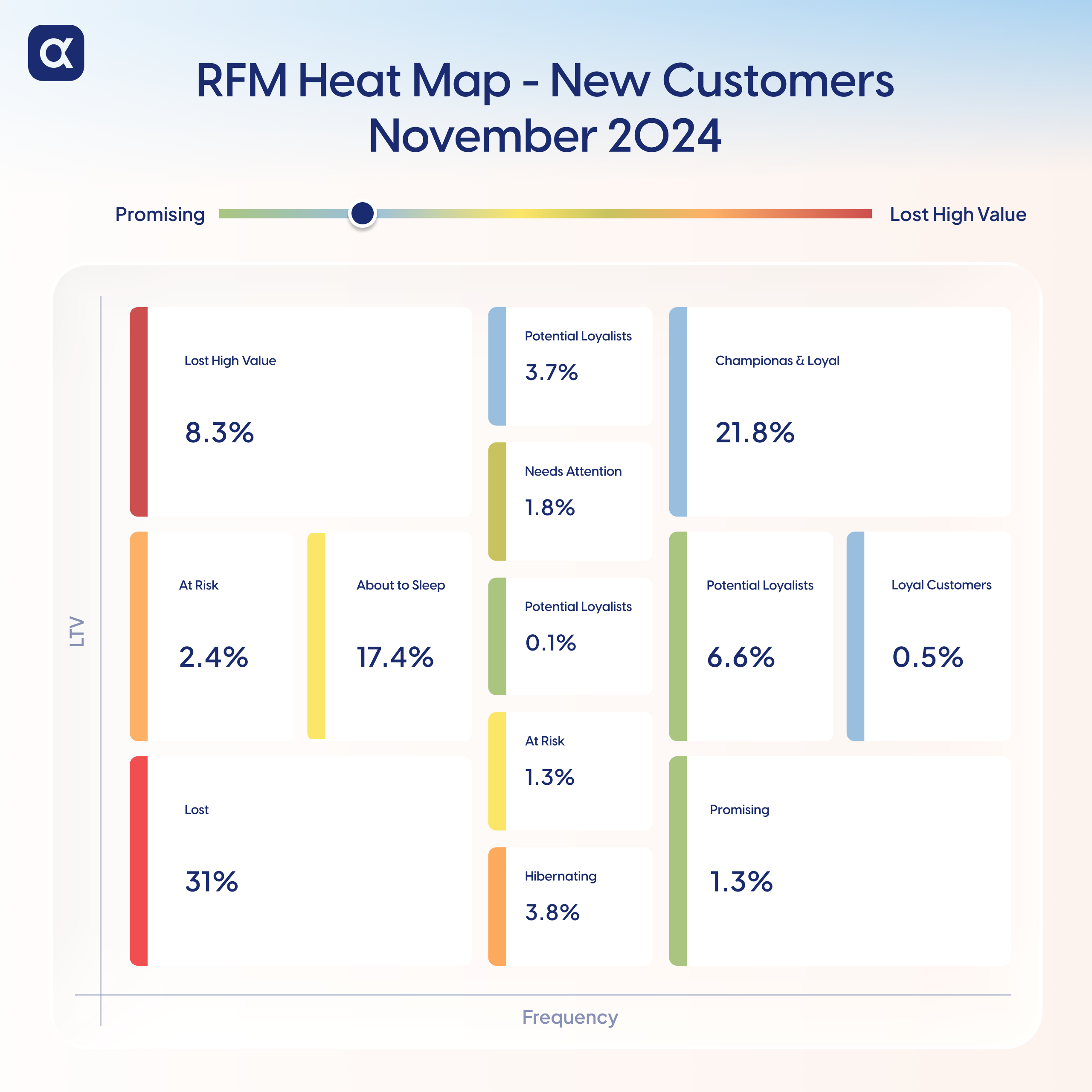
Our customer segments guide gives examples of turning those questions into defined groups. A group such as customers with one completed order gives you a clearer starting point than “people interested in our brand.”
Then connect the observation to a test.
If a product often introduces new customers to your store, assess it for an acquisition campaign. Check its availability and margin before selecting it.
If a group repeatedly buys within a particular category, test a follow-up offer based on what they buy next and when.
If support questions repeatedly concern dimensions or compatibility, test creative that addresses that uncertainty. Make the same information easy to find on the landing page.
In each case, the data supplies a reason to try something. The campaign result determines whether to continue.
For seasonal campaigns, incorporate those tests into your Q4 advertising budget plan so you have a clear review point before expanding spend.
How AdScale turns store data into Google and Meta campaigns#
Identifying an opportunity is only part of the work. Someone still needs to translate it into audiences, ads and ongoing campaign decisions.
AdScale connects to an eCommerce store and uses AI to analyze customer, order and product data. Its AI advertising approach connects that information to audience development, creative and campaign optimization across Google and Meta.
The AI Campaign Builder uses store data to prepare a media plan and ads that the merchant can review and refine. AdScale’s AI then adjusts bids and budget distribution within each budget group based on performance.
The merchant still sets the commercial direction: which offers make sense, what inventory can support, and what acquisition costs the business can sustain.
A bedding store example#
Consider a hypothetical homeware store whose order history shows that an entry-level bedding set frequently brings in new customers. The team confirms that the product has enough stock and margin to support an acquisition campaign.
Using AdScale’s AI Campaign Builder, the team prepares a Google and Meta media plan, then reviews the suggested audiences and ads. It develops two creative angles: one showing how easy the bedding is to wash and another explaining the material and feel. Both link to a product page that answers those questions with accurate specifications and care instructions.
Before launch, the team sets a spend limit and a target acquisition cost based on its margins. It reviews purchases and acquisition costs alongside ad engagement, and checks new-customer orders in its store records. If the ease-of-care angle brings purchases at a sustainable cost, the next step is to develop more creative around that benefit. If it attracts clicks but few orders, the team checks the offer and landing page before increasing spend.
How Ed Hardy refined its advertising#
AdScale’s Ed Hardy North America case study describes a similar move from analysis to action. The team identified overly broad audience targeting and product selection, weak optimization and long intervals between repeat purchases. It then refined the combinations of audience segments, products and advertising channels, with ongoing AI optimization and expert management through AdScale Plus.
The useful lesson is the sequence: identify a specific weakness, change the campaign around it, then evaluate performance as spend grows. This case concerns paid advertising; improving visibility inside AI shopping assistants remains a separate task.
Five practical steps to take this week#
- Establish your traffic baseline. In GA4, review session acquisition by channel and source. Google’s channel definitions include an AI Assistant channel for recognized assistant referrals. Organic clicks from Google AI Overviews and AI Mode are included in Organic Search, so the AI Assistant row is not a complete measure of AI-influenced discovery.
- Compare orders alongside visits. Record sessions, purchases, revenue and order value for a consistent period. Google’s traffic-source guidance distinguishes session sources from first-user sources. Keep the scope consistent, and investigate differences between analytics and store records before drawing strong conclusions.
- Improve one product page and check its feed. Use the comparison checklist above for a page receiving relevant traffic or supporting an upcoming campaign. Resolve missing specifications and unclear delivery or return terms, then check that the product feed matches the page’s price and availability.
- Choose one advertising hypothesis. Use an observation from your orders, customer groups or product questions. Write down what you expect to change, such as more new-customer purchases from a particular product. Keep the test focused enough to interpret.
- Set the review criteria before launch. Agree on a spend limit, the acquisition cost your margins support and a review point that allows for the buying cycle. Evaluate enough purchases to avoid letting one unusually large order dictate the decision.
Frequently asked questions#
AI shopping traffic refers to visits that reach an online store through links in AI tools used for product research or recommendations. It measures referred visits, rather than every purchase AI may have influenced. A shopper could consult an assistant and later reach the store through another source.
Not solely because AI shopping is growing. Base budget changes on your store’s acquisition costs, order quality and channel performance. Before funding a new initiative, decide what the investment will cover, how you will measure it and what would justify expanding it. Preserve campaigns that meet your business goals.
No. Conversion rate measures how often visits produce purchases. Profitability also depends on order value, discounts, product costs, fulfillment, returns and acquisition expenses. Compare the value remaining after relevant costs, and consider whether enough orders exist to support the conclusion. A small sample can produce an impressive percentage.
AdScale uses AI and store data to support audience development, ad creation and campaign optimization across Google and Meta. It helps merchants apply customer and product insights to paid advertising. Assessing AI referrals and improving product visibility in shopping assistants remain separate tasks within the broader marketing plan.
Yes. Clear, accurate product information helps shoppers compare options and gives search systems a better basis for understanding your products. Prioritize specifications, availability, prices and policies, alongside a crawlable website. These improvements support discovery, but no product-page change guarantees an AI recommendation or an increase in sales.
Choose the next test from your own store#
AI shopping gives eCommerce teams another source of questions worth investigating. Which products attract attention? What information helps people compare them? How much of that interest turns into orders your business wants more of?
You can make progress without answering every question at once.
Check the traffic you can measure. Review the value of the resulting orders. Choose one improvement to your product information and one advertising hypothesis that your store data supports.
If your next challenge is turning those insights into campaigns, see how AdScale uses store data to build Google and Meta advertising.
Let the research guide your questions. Let your store’s results guide your next investment.
Keep learning#
- Customer Segments: Definition and 15 eCommerce Examples: Turn purchase patterns into groups you can act on.
- AI Advertising for eCommerce: How AdScale Magic Works: Explore how store data informs advertising.
- Q4 2026 Ad Budget Planning: Connect testing and budget decisions to the seasonal calendar.


 Shopify
  WooCommerce
  PrestaShop
  Magento
  BigCommerce
  Opencart
  Wix
Wix 




 ,
,