




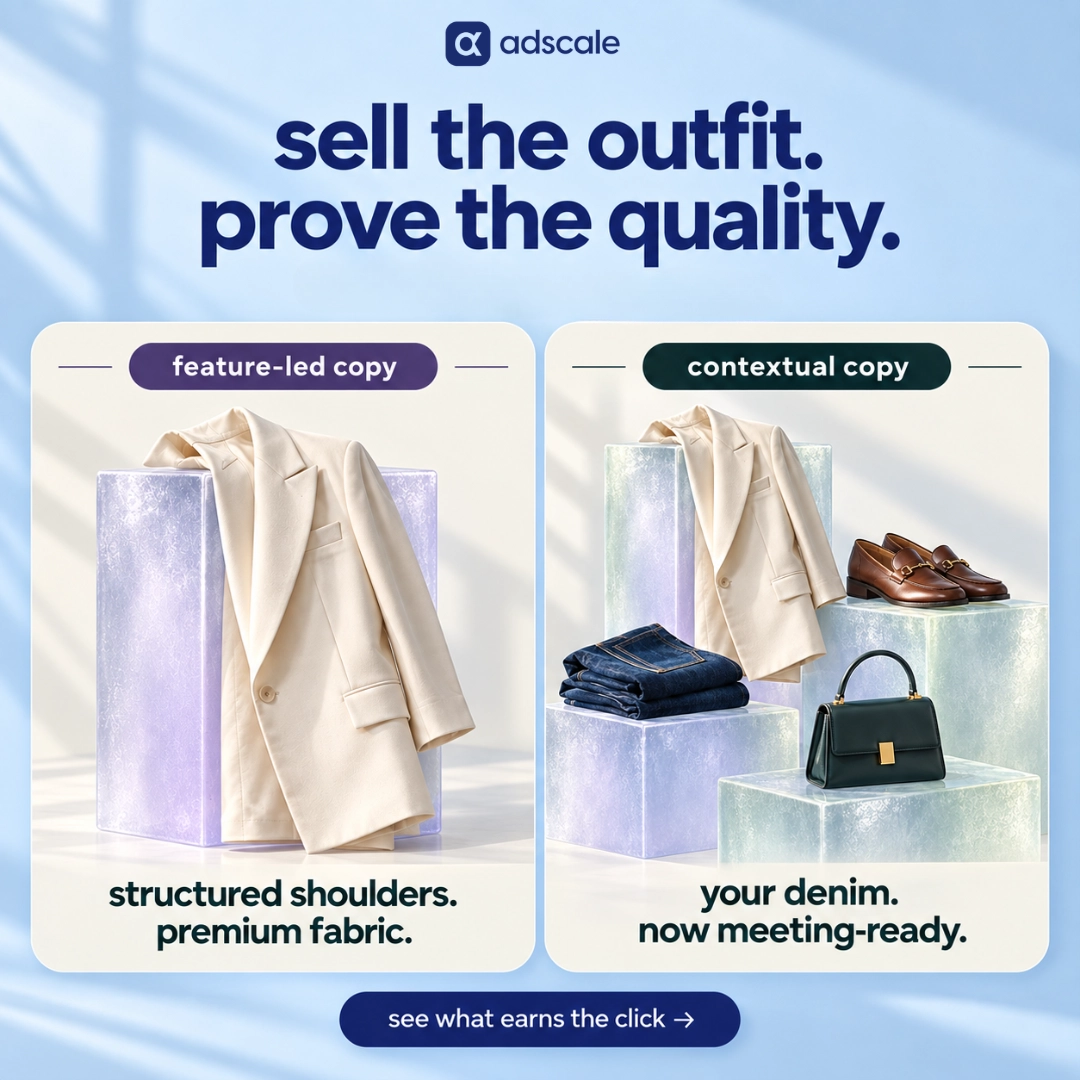


Write the outfit first. Use the product details to prove the promise.
A shopper scrolling past a clothing ad is not counting stitches. They are asking a quieter question: How would I wear this?
That is why styling-context fashion ad copy earns more attention than copy that opens with fabric, material, or construction details. Styling context places the garment inside a recognizable life: the office, the weekend, a summer wedding, a cold commute, or the jeans already hanging in the shopper’s closet. A feature list describes the product. Styling context helps the shopper picture owning it.
AdScale’s analysis of Facebook ad copy from 263 apparel and clothing advertisers found that styling-context ads earned a click-through rate roughly 42% higher than attribute-led ads. But that is only half the result. Once a shopper clicked, attribute-led copy produced a click-to-purchase rate roughly 45% higher.
The lesson is not that fashion brands should stop talking about fabric and construction. It is that one ad has two different jobs: earn attention, then justify the purchase. The data suggests a sequence worth testing. Lead with the wearing context. Follow with the product proof.
Key Takeaways
- Styling-context ads recorded a 1.62% click-through rate, compared with 1.14% for attribute-led ads in AdScale’s database.
- Attribute-led ads converted 2.11% of clicks into purchases, compared with 1.45% for styling-context ads.
- Cost per conversion was close, with attribute-led copy approximately 3% cheaper, so neither approach won the whole funnel by itself.
- Only about 12% of the analyzed creatives clearly committed to either approach, leaving most apparel ads stuck between vague lifestyle language and vague quality claims.
- The practical move is to test a Wear It With Sequence: show the occasion, pairing, or wardrobe role first, then tell the shopper which product attribute makes that promise credible.
Why Do Feature Lists Struggle to Win the Click?
Most apparel ad copy still reads like a wholesale hangtag:
100% organic cotton. Breathable fabric. Durable construction.
The statements may be accurate. In a crowded feed, they are also almost invisible.
The problem is mental effort. When an ad says “breathable fabric,” the shopper has to invent the situation in which breathability matters. A humid commute. A summer event. An office where the temperature never makes sense. Then they have to decide whether this specific garment solves the problem.
The shopper has to finish the ad for you. Most will not.
That is what styling-context copy changes. It completes the scene:
Light enough for the commute. Polished enough for the meeting.
The product benefit is no longer abstract. The shopper can see where the garment fits before deciding whether to click.
This is also why words such as “premium,” “timeless,” “must-have,” and “high-quality” rarely carry an apparel ad on their own. They make claims without creating a picture. In AdScale’s separate analysis of high-performing apparel ad copy, the strongest language leaned toward concrete nouns rather than decorative adjectives. Linen, loafers, office, and weekend give the brain something to work with. “Premium” asks the shopper to take the advertiser’s word for it.
Material information still matters. It simply answers a later question. At the scroll stage, the shopper is asking, “Does this fit my life?” After the click, they are more likely to ask, “Will it fit, feel good, last, and justify the price?”
Different moments need different information.
What Are Fashion Shoppers Actually Trying to Solve?
Fashion discovery has become easier. Getting dressed has not.
Research commissioned by ASOS and conducted with Attest among 1,952 UK consumers in July and August 2026 found that 68% believed knowing what to buy was easier than knowing how to wear it. One-third had abandoned a purchase because they could not picture how they would wear the item. Another 46% said help integrating a new purchase into their existing wardrobe would improve their fashion decisions. ASOS published the complete methodology and findings.
Those findings identify the same gap visible in the ad data. Shoppers do not lack products. They lack context.
That changes the job of fashion ad copy. The copy should not merely announce that a blazer exists. It should reduce uncertainty around the role that blazer can play:
- Where would I wear it?
- What would I wear it with?
- What does it add to the wardrobe I already own?
This is more than a creative preference. Context can act as a decision aid. It helps the shopper move from “I like that” to “I know what I would do with that.”
There is a commercial opportunity inside that shift. The same ASOS research found that 55% of respondents had bought additional items to complete a look. “Complete the look” is not only a merchandising module. It solves the outfit puzzle while giving the shopper a reason to consider the second item.
The ad starts that process. The product page, cart, and post-purchase communication should continue it.
How Did AdScale Compare Styling-Context and Attribute-Led Ad Copy?
AdScale analyzed Facebook ad body copy from merchants in its Apparel & Accessories and Clothing verticals. The database included:
- 263 active advertisers
- 119,670 individual ad creatives containing body text
- More than one billion combined impressions
- Campaign data spanning late 2022 through September 8, 2026
The creatives were checked against two language patterns.
Styling-context copy included pairings, occasions, transitions, silhouettes, climate, and fit utility. Examples include “wear it with,” “pairs with,” “tuck it into,” and specific references to where or when the product would be worn.
Attribute-led copy emphasized fabric, material, origin, construction, weight, durability, and quality claims.
The analysis compared performance at three different points: click-through rate, click-to-purchase rate, and cost per completed conversion. This distinction matters because a single conversion metric can hide the different work each copy style performs.
This was an observational analysis across many advertisers, products, audiences, offers, and creative formats. It was not a randomized experiment using one product and one controlled visual. The results show a strong pattern across the database, not a promise that changing one sentence will produce the same lift for every apparel brand.
What Did the Apparel Ad Data Show?

Styling-context copy generated more clicks, while attribute-led copy converted more of those clicks into purchases. Source: AdScale apparel creative analysis, late 2022 to September 8, 2026.
| Metric | Styling-context copy | Attribute-led copy |
|---|---|---|
| Click-through rate | 1.62% | 1.14% |
| Click-to-purchase rate | 1.45% | 2.11% |
| Cost per conversion | Approximately 3% higher | Baseline |
Styling context was stronger at earning the click
Ads using styling-context language recorded an average click-through rate of 1.62%. Attribute-led ads recorded 1.14%.
That makes the styling-context rate roughly 42% higher. In the feed, showing the shopper where the garment belongs was more effective than opening with what the garment was made from.
Attribute language was stronger after the click
Once someone clicked, the result reversed. Attribute-led ads converted 2.11% of clicks into purchases, compared with 1.45% for styling-context ads.
The attribute-led click-to-purchase rate was therefore roughly 45% higher. After showing initial interest, shoppers appeared more responsive to concrete reassurance about the product itself.
Cost per conversion finished close
Despite the differences at each stage, the final cost per conversion was similar. Attribute-led copy came in approximately 3% cheaper.
That result prevents an easy but misleading conclusion. Styling context was not the universal winner. Neither was attribute copy. One was better at attracting attention. The other was better at turning the resulting attention into a purchase.
Most fashion ads were doing neither job clearly
Only about 12% of all analyzed apparel creatives clearly committed to one of the two approaches. The remaining 88% mixed generic lifestyle statements with generic quality claims.
That is the real whitespace. Most brands are not choosing between a sharp styling hook and persuasive product proof. They are running copy that offers neither.
What Is the Wear It With Sequence?
The data did not directly test a hybrid format that combined styling context and attribute proof inside the same ad. It therefore cannot prove that a combined sequence will outperform both categories.
It does, however, reveal two complementary strengths. That leads to a practical hypothesis apparel brands can test: show the wearing context first, then tell the shopper why the product can deliver it.
The pattern is worth naming: the Wear It With Sequence
Step 1: Show the garment in the shopper’s life
The opening should answer at least one of three questions:
- Where am I wearing this?
- What am I wearing it with?
- How does it improve what I already own?
The first line does the work of a stylist standing beside the shopper’s closet. It gives the garment a role, a pairing, or a moment.
Step 2: Tell the shopper why the promise holds up
The next line introduces the relevant attribute as evidence. Fabric, construction, weight, stretch, and care information are no longer disconnected specifications. They explain why the opening promise is credible.
Consider the difference:
Attribute only:
Heavyweight 400GSM cotton.
Styling context only:
The sweatshirt that still looks structured at dinner.
Wear It With Sequence:
The sweatshirt that holds its shape from the flight to dinner. Cut from heavyweight 400GSM cotton for a structured drape that lasts through the day.
The same product detail is present. It now has a job.
How Can You Rewrite Attribute-Led Fashion Ads?
The goal is not to hide the features. It is to translate them into a wearing benefit, then keep the original attribute as proof.
Example 1: Linen shirt
Before:
100% premium linen. Lightweight and breathable.
After:
Made for the humid commute and the meeting after it. Woven from lightweight linen that lets air move without losing its shape.
Example 2: Blazer
Before:
Structured shoulders. High-quality construction. Timeless design.
After:
The blazer that turns last year’s denim into a meeting outfit. A structured shoulder keeps the silhouette sharp without making it feel formal.
Example 3: Basic T-shirt
Before:
Soft organic cotton. An everyday essential.
After:
Clean under a blazer. Easy with denim on the weekend. Soft organic cotton keeps it comfortable enough to stay in rotation.
Example 4: Occasion dress
Before:
Flattering fit. Elegant fabric. Premium finish.
After:
For the wedding that starts in the sun and ends on the dance floor. A fluid, crease-resistant fabric keeps the line clean through both.
The strongest rewrites are product-specific. “Style it your way for every occasion” is not styling context. It is a vague claim wearing lifestyle language. If the line could be pasted onto every product in the catalog, it has not done enough work.
Does Attribute Copy Still Matter for Luxury and High-Price Products?
Yes. The higher the price, the more proof the shopper may need. The question is where that proof appears.
For prospecting ads, context can create recognition and desire. For retargeting ads and product pages, detailed attributes can reduce risk and justify the price. Fiber origin, fabric weight, construction, care, certifications, and manufacturing details all belong in the journey.
They work harder once the shopper understands the benefit they support.
“Italian merino” is useful information. “The knit that holds its shape from the morning meeting through dinner” gives that information a reason to matter. Together, they answer both sides of the decision: why the shopper wants the garment and why this particular version is worth buying.
The sequence should continue after the ad. If the hook promises an office-to-dinner transition, the landing page should show that transition in its imagery and repeat it near the top of the product description. A contextual hook attached to a disconnected product page earns a click the site may immediately lose.
The same principle can continue after checkout. Specific confirmation-email product tips can reinforce how the product fits, layers, or pairs before the package arrives.
How Should Apparel Brands Test the Wear It With Sequence?
1. Classify the current ad library
Sort active ad copy into three groups: styling-context, attribute-led, and neither. Do this before looking at the performance columns. Most brands will discover that “neither” is their largest category.
2. Start with high-spend ads, not favorite ads
Prioritize the copy receiving the most budget. If the highest-spend line could run unchanged for any mid-market clothing brand, the account is paying to be generic.
3. Rewrite only the opening line
Use one occasion, pairing, transition, silhouette cue, or real-life problem. Keep the image, audience, product, and offer unchanged for the first test. Isolating the hook makes the result easier to interpret.
4. Turn the attribute into evidence
Move fabric and construction details into the second sentence. Connect each attribute directly to the opening benefit. Do not attach an unrelated list underneath the hook.
5. Match the visual to the copy
If the line says “loafers for the office,” the creative should show the pairing or make the office logic clear. Styling-context copy over a product-only cutout creates a gap the shopper has to repair.
AdScale’s related analysis of lifestyle images versus product cutouts found the same contextual advantage on the visual side. The image and copy should finish the same thought.
6. Measure the full journey
Track click-through rate, landing-page engagement, add-to-cart rate, click-to-purchase rate, and cost per conversion. CTR alone could make the styling hook look like a complete success even if the landing page fails to close the sale.
7. Confirm the pattern in your own category
Basics, outerwear, occasion wear, luxury products, and activewear do not behave identically. Test the sequence against your own products and audience before reallocating meaningful budget. The broader database supplies the hypothesis. Your account supplies the decision.
Frequently Asked Questions
Styling-context fashion ad copy describes how, where, or with what a garment can be worn. It leads with an occasion, outfit pairing, wardrobe role, silhouette, or practical situation instead of opening with fabric and construction details. Its first job is to help the shopper picture the product inside their life.
Styling-context copy reduces the mental work required to understand the benefit. Instead of asking shoppers to translate “breathable fabric” into a relevant situation, it shows them the commute, occasion, outfit, or problem directly. In AdScale’s database, this approach recorded a 1.62% CTR versus 1.14% for attribute-led copy.
No. Attribute information remains valuable, especially after the shopper has shown interest. AdScale’s analysis found that attribute-led ads converted clicks into purchases at a higher rate. Use styling context to establish relevance, then present fabric, construction, origin, or care information as proof that the promised benefit is credible.
The Wear It With Sequence is a testable ad-copy structure based on two steps. First, show where the garment fits by naming an occasion, pairing, or wardrobe role. Second, tell the shopper which product attribute makes that promise believable. It combines a contextual hook with concrete product proof.
Hold the product, visual, audience, and offer constant while changing the copy structure. Measure click-through rate and post-click outcomes, including landing-page engagement, add-to-cart rate, click-to-purchase rate, and cost per conversion. The test succeeds only if it improves the business result, not merely the number of clicks.
The Bottom Line
A clothing ad has a few seconds to finish a sentence the shopper started before seeing the brand: I need something I will actually wear.
Feature lists often answer the wrong question first. They explain the garment before the shopper has decided that it belongs in their life. Styling context reverses that order. It shows the office, the weekend, the weather, the silhouette, or the pieces already in the closet.
Then the product details can do what they do best. They can prove the garment will hold its shape, feel comfortable, survive the day, and justify the price.
The data does not say to choose style over substance. It shows that they solve different problems at different moments. Test them in the order the shopper experiences them: recognition first, reassurance second.
Write the outfit first. Let the fabric prove it.
Keep Learning
- Apparel Ad Copy That Converts: What High-Performing Words Reveal – See which language patterns separate stronger apparel ads from generic copy.
- Does the Word “Best” Hurt Your ROAS? – Learn why broad status claims can weaken advertising performance.
- Why Lifestyle Images Outperform Product Cutouts – Explore the visual counterpart to styling-context copy.
- Can Confirmation Email Tips Reduce Ecommerce Returns? – Continue the styling and product-education journey after checkout.
- Clothing Industry Ad Benchmarks – Put creative performance inside the wider Google and Meta advertising picture.
About AdScale
AdScale is an AI advertising platform for eCommerce brands running Google and Meta campaigns. It uses first-party store data to help teams understand customers, manage campaigns and optimize budgets around the economics of the business.

 Shopify
  WooCommerce
  PrestaShop
  Magento
  BigCommerce
  Opencart
  Wix
Wix 







 ,
,