



On this page
- Key Takeaways
- Why Are Fashion Brands Cutting Email Budget for SMS?
- What Does the 2026 Benchmark Data Show About Email vs SMS Revenue?
- Why Does Intent Matter More Than Channel in Retention Marketing?
- How Should Fashion Brands Rebuild Their Email and SMS Strategy?
- How Do You Fix Your Email and SMS Mix?
- Frequently Asked Questions
- What’s the Bottom Line on Email vs SMS for Fashion Brands?
- Keep Learning
Fashion brands are shifting budget from email to SMS. The data says they’re solving the wrong problem.
Email isn’t dying. The Tuesday-afternoon blast to your entire list is.
That distinction matters more than any channel debate. Right now, a lot of fashion brands are reading their email numbers, panicking, and shifting budget to SMS. They’re treating SMS like a different, healthier species of marketing. It isn’t. A triggered message beats a scheduled blast almost every time, in both channels. It reaches the right person, at the right moment, based on something they actually did. Not by a little, either. By 8 to 18 times, depending on which platform’s benchmark data you’re reading.
So the real question isn’t “email or SMS.” It’s “blast or trigger.” Get that right and the channel mix mostly sorts itself out.
Key Takeaways#
- Email isn’t declining as a channel. Broadcast campaigns are, relative to automated flows. Flows generate 18 times more revenue per recipient, per Klaviyo’s 2026 email benchmark data.
- SMS shows the identical pattern. Automated flows generate roughly 8 times more revenue per recipient than SMS campaigns. They drive 45% of SMS revenue from just 7.6% of sends, per Klaviyo’s 2026 SMS benchmark data.
- Apple’s Mail Privacy Protection has been live since 2021. It now affects roughly 64% of B2C subscribers and has made open rate an unreliable metric. Click rate and revenue per recipient are what to trust instead.
- Fashion shopping has gone mobile enough to change which channel reaches a customer first. It hasn’t changed which strategy wins. Intent-based sending beats blast sending on both channels.
- Cutting email budget to fund SMS blasts just moves the same mistake to a more expensive channel.
Why Are Fashion Brands Cutting Email Budget for SMS?#
You’ve seen the graph. Open rates climbing, revenue per email sliding. Somewhere in a Monday marketing meeting, someone says “email is dead, we should be all-in on SMS.” The budget starts moving before anyone checks whether that’s actually the right read of the data.
I get the instinct. Inbox competition for fashion brands is brutal, especially around big sale windows. A text message feels like it lands with more certainty than an email sitting in a Promotions tab. The same platform-hopping reflex shows up on the paid acquisition side. A channel underperforms for a quarter, and the whole budget swings to whatever looks hot, rather than to what the underlying return-on-spend data actually supports. But “feels more certain” and “is more profitable” are different claims. The brands that skip straight to the second one usually end up disappointed. They pour spend into SMS and treat it the same way they treated email: a list to blast on a schedule. The same decay shows up in the new channel. It just happens faster, and at a higher per-message cost.
Most of that decay traces back to one habit. Brands treat a list like a broadcast audience, instead of a set of people who each did something different to get on it.
What Does the 2026 Benchmark Data Show About Email vs SMS Revenue?#
Start with email. Klaviyo’s 2026 benchmark data, drawn from more than 183,000 eCommerce brands, shows a stark split between two things that get lumped into one “email performance” number: campaigns and flows. Campaigns are the scheduled sends: promotions, new arrivals, sale announcements. Flows are the automated, behavior-triggered messages: welcome series, cart abandonment, back-in-stock alerts, post-purchase follow-ups.
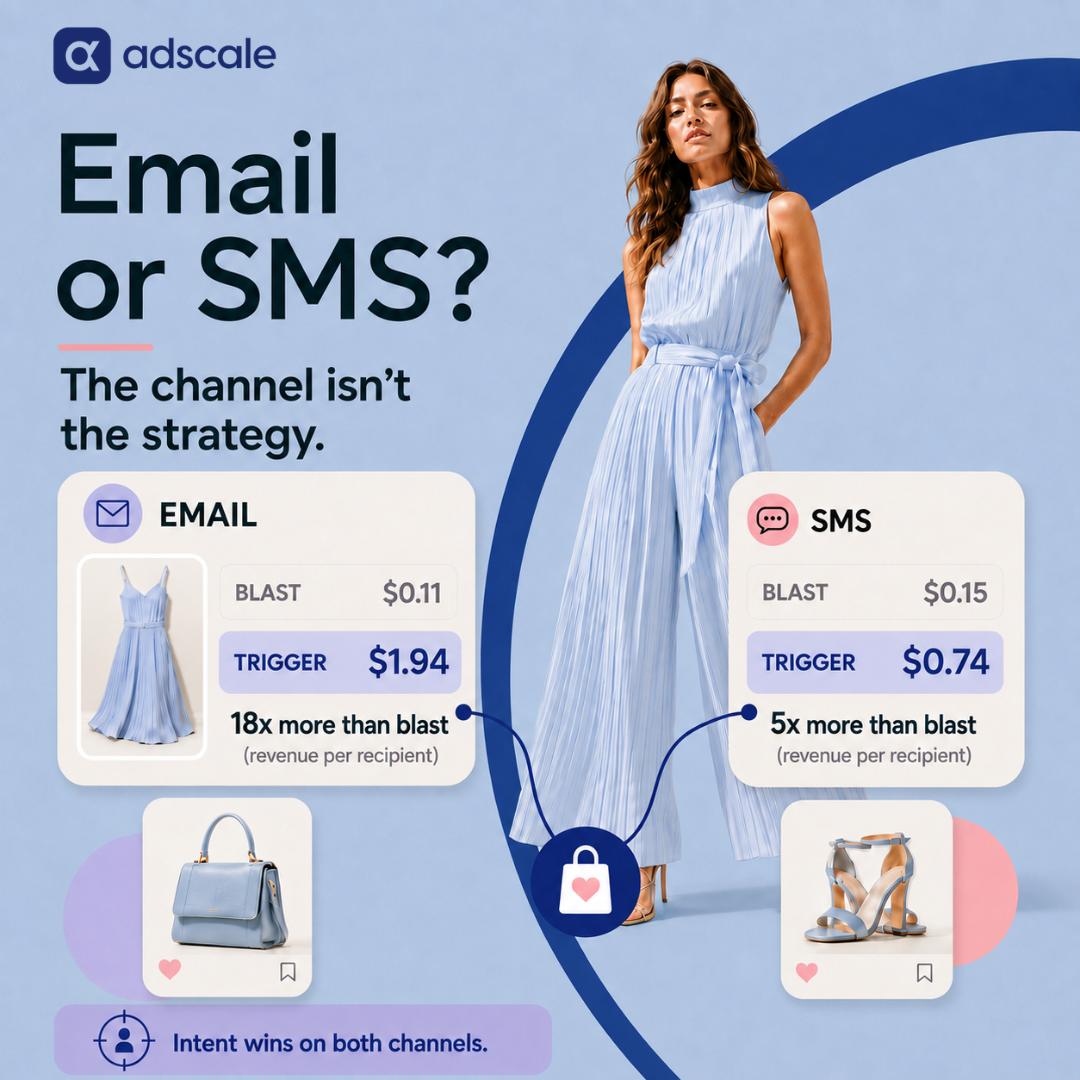
Campaigns average about $0.11 in revenue per recipient. Flows average about $1.94. That’s an 18x gap, and it holds even though flows make up only about 5% of total email sends. The other 95% of sends (the campaigns) generate less than 60% of the revenue. Omnisend’s 2026 eCommerce report, built from 150,000 brands and over 27 billion emails sent in 2025, found the same shape from a different data set: automated emails made up just 2% of sends but drove 30% of revenue, earning roughly 16 times more per send than scheduled campaigns.
SMS follows the identical curve. Klaviyo’s SMS benchmarks show flows account for only 7.6% of SMS sends, yet generate 45.2% of total SMS revenue, with flows averaging about 8 times the revenue per recipient of SMS campaigns. The top 10% of SMS flows clear more than $5 in revenue per recipient. Omnisend’s data lines up here too: automated SMS earned about $0.74 per send in 2025, versus $0.15 for scheduled SMS campaigns, a fivefold gap.
Why Is Open Rate No Longer a Reliable Metric?#
Now, the open rate problem. Apple’s Mail Privacy Protection has been live since iOS 15 in September 2021, not a recent change. What is recent is how many subscribers it now covers: roughly 64% of B2C email subscribers read mail through an MPP-capable client, which means the majority of “opens” reported by most email platforms are the app pre-loading a tracking pixel, not a person actually reading the message. That inflation has been building for four years. It’s why click rate and revenue per recipient, not open rate, are the metrics worth building a strategy around.
The underlying lesson isn’t new to retention marketing specifically. AdScale found the same pattern on the paid media side: ad spend that ignores timing data leaves real return on the table, because budgets tend to move evenly across a day (or a channel) while the actual returns concentrate in specific windows. Blast email and blast SMS make the identical mistake: they spend attention evenly across a list instead of concentrating it where intent is highest.
Why Does Intent Matter More Than Channel in Retention Marketing?#
Call it the Intent Premium: the revenue difference between a triggered message and a broadcast message, and it shows up at nearly identical magnitude in email and SMS. That’s the tell. If email itself were the failing channel, SMS flows and SMS campaigns wouldn’t show the same 8x gap that email flows and email campaigns show. Two different channels, same underlying pattern. The variable isn’t the pipe the message travels through. It’s whether the send was earned by something the customer did.
This is where AdScale’s own order data adds a piece the platform benchmarks can’t: where fashion shoppers actually are when they buy. Across active Apparel & Accessories and Clothing stores in AdScale’s network, mobile accounted for 60.4% of orders in the second quarter of 2026, up slightly from 59.6% in the first quarter. That’s not a blip; it’s held steady across two consecutive quarters, and it’s exactly the terrain SMS is built for. A text lands on the device someone is already holding. An email competes with a crowded inbox they may only open on desktop once a day.
But that doesn’t make mobile the whole story either. AdScale’s data on German apparel shoppers found desktop orders running about 24% higher in average order value than mobile, even though mobile drives the majority of traffic there too. Mobile wins on reach. Desktop, where it holds share, often wins on basket size. It’s the same reason blended AOV comparisons between markets like the UK and US fall apart once you look at what’s actually driving the gap. The lesson isn’t “go all-in on the mobile-native channel.” It’s “match the channel and the moment to what the customer is actually doing,” which is the same discipline that makes flows outperform blasts in the first place.
How Should Fashion Brands Rebuild Their Email and SMS Strategy?#
If your email revenue is sliding, the fix almost never starts with the subject line. It starts with an audit of what’s actually sending: how much of your volume is scheduled campaigns versus behavior-triggered flows, and how much revenue each side is producing per recipient. Most fashion brands are heavier on campaigns than they realize, because campaigns are easy to plan on a content calendar and flows require setup work up front. That audit is worth the same rigor brands already apply to paid spend efficiency: it’s a retention-side version of the ROAS math most teams only run on ad budgets.
The same audit applies before any SMS budget increase. SMS earns its premium reputation almost entirely through flows: cart abandonment at a real dollar threshold, back-in-stock alerts for a genuinely popular size, shipping updates that save a customer a support ticket. Post-purchase flows deserve particular attention in fashion specifically, since multi-item baskets carry a meaningfully higher return risk, and a well-timed post-purchase message (sizing guidance, a fit-confidence nudge) can catch that risk before the return window opens rather than after. Blast SMS on a promotional schedule runs into the same fatigue and unsubscribe pressure email blasts do, just with a lower tolerance, because a text message is a more personal space than an inbox and customers punish overuse faster.
None of this means email is safe to ignore or that open rate deserves a quiet retirement without a plan. It means the plan should be built around the metric that actually tracks revenue, and the message type that has already proven, in two independent 2026 industry data sets, to carry nearly all the value.
How Do You Fix Your Email and SMS Mix?#
- Pull your flow-versus-campaign revenue split for the last 90 days. Most platforms report this natively. If you can’t find the number, that’s the first gap to close before touching your SMS budget.
- Stop reporting open rate as your primary email health metric. Track it for A/B test comparisons only, where both variants are affected equally by Apple MPP. For everything else, use click rate and revenue per recipient.
- Build or audit your five core flows before adding SMS spend: welcome series, cart abandonment, back-in-stock, post-purchase, and win-back. These are where the 18x revenue gap lives.
- Reserve SMS for genuinely high-intent triggers, not weekly promotions. Cart abandonment above a meaningful dollar threshold and back-in-stock alerts for items with real waitlists are the two highest-converting SMS use cases across the industry data.
- Clean your SMS list before scaling send volume. Unlike email, SMS carries a real per-message cost, so an unengaged subscriber is a direct expense every time you send, not just a deliverability risk.
- Segment by device behavior where you can. If mobile drives most of your traffic but desktop drives a disproportionate share of your highest-value orders, your highest-AOV flows deserve a desktop-optimized experience too.
- Set a quarterly retention audit that reports flow revenue share, campaign revenue share, and SMS revenue share side by side, so budget conversations start from the same three numbers every time.
Frequently Asked Questions#
No. Automated email flows generate roughly 18 times more revenue per recipient than scheduled campaigns, according to Klaviyo’s 2026 data. What’s declining is the effectiveness of broadcast campaigns specifically, not email as a channel.
Mail Privacy Protection launched with iOS 15 in September 2021 and now covers roughly 64% of B2C email subscribers. It pre-loads tracking pixels regardless of whether someone actually reads the email, inflating open rates and making them unreliable as a performance metric.
Revenue per recipient (RPR) is total attributed revenue divided by the number of people a message was sent to. Unlike open rate, it isn’t distorted by pixel pre-loading, and it ties directly to what a marketing program is actually meant to do: generate revenue.
No. SMS shows the same blast-versus-flow gap email does. Automated SMS generates roughly 8 times more revenue per recipient than scheduled SMS campaigns, per Klaviyo’s 2026 SMS benchmarks. Moving budget without shifting strategy just repeats the same mistake, on a channel that costs more per message.
Across AdScale’s network of active apparel and clothing stores, mobile accounted for 60.4% of orders in Q2 2026, consistent with 59.6% the prior quarter. Desktop still carries a meaningfully higher average order value in some markets, so mobile share alone shouldn’t dictate channel strategy.
What’s the Bottom Line on Email vs SMS for Fashion Brands?#
Every few years, a channel gets declared dead, and every time, the postmortem turns out to be premature. Email isn’t dying. The habit of sending the same message to everyone on the same day, and calling it a strategy, is dying, and it’s dying in SMS just as fast as it died in email. The brands winning retention in 2026 aren’t the ones that picked a side in the email-versus-SMS argument. They’re the ones that stopped asking which channel to use and started asking which moment earned a message at all.
Keep Learning#
- Why Are Fashion Ecommerce Return Rates So High for Multi-Item Orders?: the same “don’t treat the average customer as your only customer” discipline, applied to returns instead of retention.
- German Apparel Desktop vs Mobile AOV: The 24% Gap: the device-level data behind this post’s point that mobile share and order value don’t move together.
- Why Do UK Clothing Shoppers Spend Over 50% More Per Order Than US Shoppers?: another example of why blended, market-wide averages hide the decisions that actually move revenue.
- Clothing Industry Ad Benchmarks: What 100M+ eCommerce Orders Reveal About Google vs. Meta: the acquisition-side counterpart to this post’s retention-side argument.
- What Is the Best Time of Day to Run eCommerce Ads?: the paid-media version of the timing argument at the center of this post.
- Understanding Poor Ad Performance: Why Your ROAS Is Low and How to Fix It: the acquisition-side playbook for the same “audit before you shift budget” discipline.


 Shopify
  WooCommerce
  PrestaShop
  Magento
  BigCommerce
  Opencart
  Wix
Wix 




 ,
,