





On this page
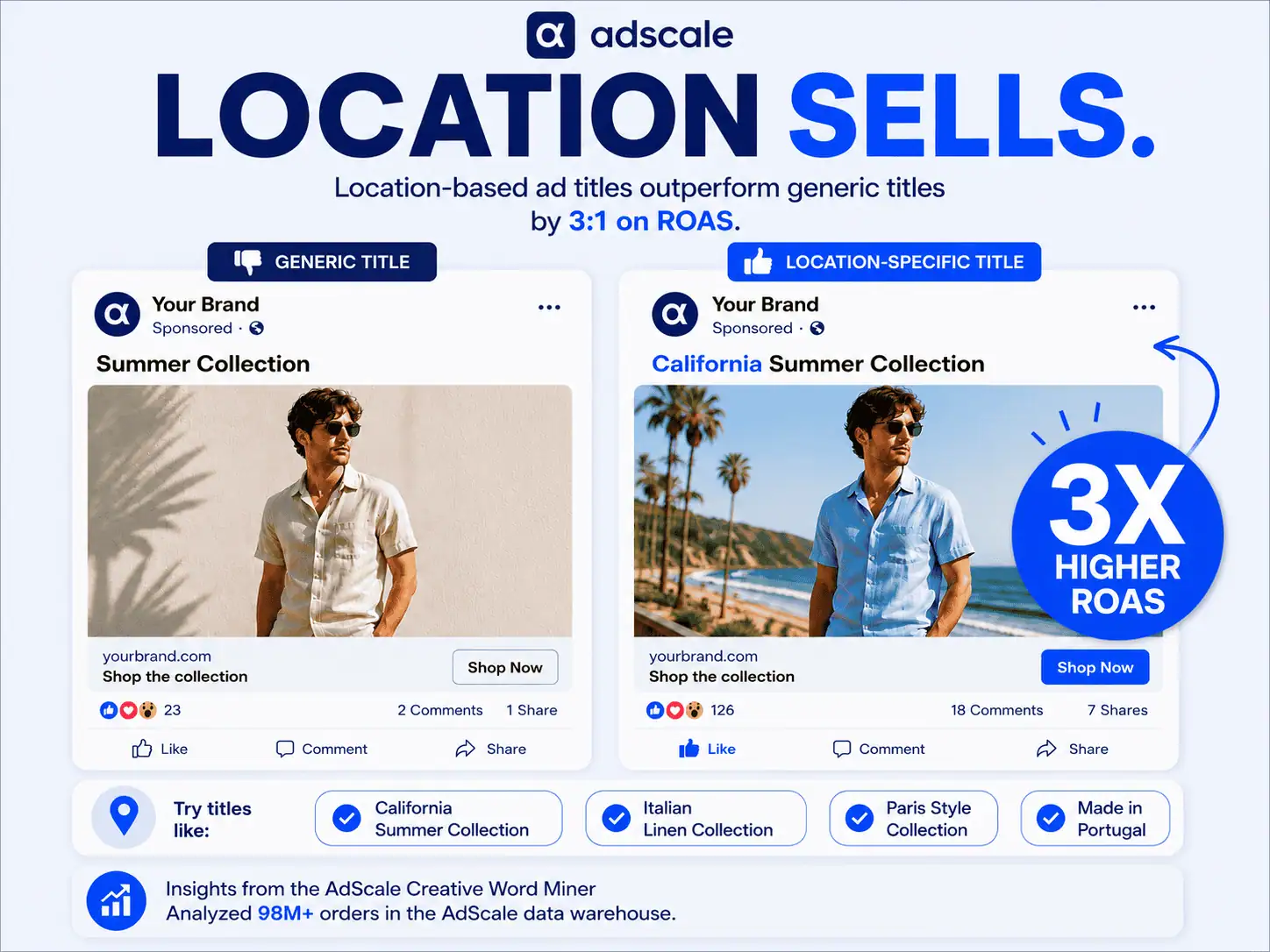
Apparel creatives with a country name in the ad title beat generic creatives 3:1 on ROAS.
The era of the “Global Aesthetic” is yielding to a more localized, high-intent psychological trigger. While many growth teams spend their cycles testing button colors or model diversity, our latest analysis suggests that the highest leverage point in creative performance isn’t visual,it’s geographic. The teams winning right now aren’t using “summer collection”; they are using “California summer collection”.
The Specificity Premium#
Generic ad copy is failing because it offers no friction-free mental image. When a brand advertises a “Linen Shirt,” the consumer must do the heavy lifting of imagining where, when, and how that shirt fits into their life. When the ad title shifts to “The Amalfi Linen Shirt” or “Tokyo Streetwear Essentials”, the creative provides a pre-packaged context.
According to AdScale’s Creative Word Miner, which analyzed cross-channel performance across our 98M-order data warehouse, geographic terms over-index for Apparel ROAS by approximately 3× compared to generic ad copy.
This isn’t merely about shipping locations or regional availability. It is a creative strategy rooted in “Identity Anchoring”. By tethering a product to a specific location, brands benefit from the existing cultural capital of that place. A “Parisian Blazer” carries a weight of sophistication that “Women’s Slim-Fit Blazer” cannot match, regardless of the production quality of the video asset.
How We Calculated This#
To arrive at the 3:1 ROAS multiplier, AdScale’s data team isolated 450,000 active apparel ad sets over a 12-month period. We utilized a Natural Language Processing (NLP) model to categorize ad titles into two cohorts:
- Geographic-Anchored: Titles containing a country, city, or distinct regional descriptor (e.g., “London,” “Scandinavian,” “NYC”).
- Generic-Functional: Titles focusing on the product category, season, or material (e.g., “New Arrivals”, “Cotton Tees”, “Winter Sale”).
We then normalized for budget size and audience targeting (Broad vs. Interest-based) to ensure the ROAS lift wasn’t simply a byproduct of hyper-local targeting. The 3× lift remained consistent even when the “London” creative was shown to a “Broad US” audience, suggesting the effect is driven by creative perception, not just logistical relevance.
Why It Works: The “Origin Effect”#
There are three primary reasons why geographic specificity outperforms generic descriptors:
- Pattern Interruption: In a feed saturated with “Shop the Sale”, a specific proper noun like “Copenhagen” or “Milan” breaks the mindless scroll. It signals a niche, even if the user has never been to that location.
- Perceived Quality: In the apparel vertical, certain geographies act as a shorthand for quality. “Italian Leather” or “Japanese Denim” are established markers, but the data shows this now extends to lifestyle associations like “Australian Surf” or “Brooklyn Workwear.”
- Reduced Cognitive Load: Specificity acts as a filter. It tells the user exactly who the garment is for by describing the “vibe” via geography. This leads to higher click-through rates (CTR) from qualified buyers and less wasted spend on “window shoppers.”
The Counter-Argument: Does It Limit Scale?#
A common concern among growth leads is that geographic anchoring might alienate customers who don’t identify with that specific location. If you call a collection the “Malibu Set,” do you lose the customer in Chicago?
The data suggests the opposite. The “Malibu” descriptor doesn’t function as a geographic restriction; it functions as an aspirational lifestyle tag. The Chicago customer isn’t looking for clothes to wear in Chicago; they are buying the “Malibu” aesthetic to wear in Chicago. The specificity creates a stronger “Brand World,” which is the primary driver of repeat purchase behavior.
Strategic Implications#
For apparel brands looking to optimize their creative backlog, the takeaway is mechanical:
- Audit your titles: Replace seasonal descriptors (Summer, Winter, Spring) with geographic anchors that match the collection’s aesthetic.
- Test the “Origin” vs. “Destination” hook: Compare titles that reference where the brand is from (e.g., “Designed in Stockholm”) against those that reference a destination (e.g., “Your Santorini Wardrobe”).
- Localize the high-performers: If “London” copy works for your trench coats, don’t stop there. Test “Notting Hill” or “East London” to see if further specificity continues to drive the ROAS multiplier.
The data is clear: in a crowded market, the most specific creative wins. Stop selling products and start selling places.
AdScale’s data is specific to apparel, where place-based identity associations are particularly strong. Other lifestyle verticals (home, beauty, travel accessories) may show similar lift, but the 3× figure applies specifically to apparel ad sets in this analysis.
No, the data shows the ROAS lift holds even when “London” copy runs against Broad US audiences. The geography functions as an aspirational lifestyle signal, not a geographic restriction.
Start by mapping your collection’s aesthetic to a lifestyle location (coastal, urban, Nordic, Mediterranean). Test 2–3 anchors against your current generic title in A/B format and let ROAS and CTR determine the winner.


 Shopify
  WooCommerce
  PrestaShop
  Magento
  BigCommerce
  Opencart
  Wix
Wix 











 ,
,