





On this page
An AI advertising tool for eCommerce is a platform that automates campaign creation, bidding, budget allocation, and creative testing across ad channels using a store’s own sales and customer data.
Google and Meta are the two most important acquisition channels for eCommerce brands, and AI tools help merchants scale campaigns, test creatives, manage budgets, and reduce manual work across both.
This guide reviews the best AI tools for Google and Meta ads for Shopify and BigCommerce stores, highlighting what each tool actually does and when it makes sense to use it. AdScale is our product, included alongside 5 direct alternatives and compared on the same criteria so you can judge for yourself.
Overview#
AI tools for advertising fall into different categories. Some automate campaign execution. Others focus on creative analysis, attribution, or workflow efficiency.
The tools covered here are:
- AdScale
- Madgicx
- Smartly.io
- Optmyzr
- AdRoll
- Triple Whale
Each supports Google and Meta ads in a different way, with very different levels of automation.
What Makes a Good AI Tool for Google and Meta Ads#
A strong AI advertising platform for eCommerce should support:
- Automation across Google and Meta
- First-party store data usage
- Cross-channel budget management
- Creative testing or optimization
- Audience management
- Clear performance reporting
- Easy setup
- Shopify and BigCommerce compatibility
Very few tools cover all of these areas.
Top AI Tools for Google and Meta Ads (Shopify + BigCommerce)#
AdScale#
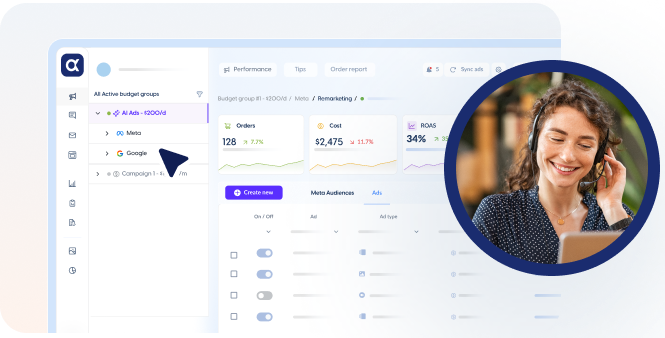
AdScale is an AI advertising platform that runs Google Ads and Meta Ads together for eCommerce stores. It connects directly to the store database, builds personas from purchase behavior, and shifts budget between the two channels in real time based on revenue and ROAS signals.
Channel coverage
AdScale focuses on Google and Meta, the two channels that carry most eCommerce ad spend. Stores that also need TikTok, Pinterest, or Snapchat managed from the same dashboard should look at Smartly.io, which covers more channels but is sales-led and built for enterprise teams rather than independent stores.
Best for
Ecommerce merchants who want automated Google and Meta advertising with minimal manual work.
Key features
- Google Ads automation
- Meta Ads automation
- Store data analysis using first-party eCommerce data
- Persona discovery and persona-based campaigns
- Automated budget allocation based on revenue and ROAS signals
- Real-time cross-channel optimization between Google and Meta
- Shopify, WooCommerce, Magento, and BigCommerce integrations
Why it stands out
AdScale is the only platform in this list built specifically for eCommerce merchants that fully automates Google and Meta together using store data, personas, and real-time cross-channel optimization.
Madgicx#
Madgicx is an AI tool focused primarily on Meta Ads.
Best for
Media buyers who want creative analysis and manual control over Meta campaigns.
Key features
- Creative scoring and visual analysis
- Audience and interest discovery
- Rule-based and partial automation
- Meta Ads focus
Why it stands out
Madgicx provides strong creative insights for Meta advertisers but does not analyze eCommerce store data, does not discover personas, and does not automate Google Ads.
Smartly.io#
Smartly.io is an enterprise platform for managing creative and media across Google, Meta, TikTok, Pinterest, Snapchat, and other channels from one dashboard.
Best for
Large brands and agencies running high-volume, multichannel campaigns with heavy creative production needs.
Key features
- Multichannel campaign management (10+ platforms),
- Dynamic creative templates and automation at scale
- Enterprise workflows and approvals
- Multi-team collaboration.
Why it stands out
Smartly.io covers more ad channels than any other tool on this list, but it’s a sales-led enterprise product, not a self-serve fit for independent Shopify/BigCommerce stores.
Optmyzr#
Optmyzr is a PPC management toolkit for Google Ads.
Best for
Experienced Google Ads specialists and agencies.
Key features
- Rule-based automation
- Scripts and alerts
- Bulk edits
- Manual bid and budget controls
Why it stands out
Optmyzr gives expert users deep control over Google Ads but does not automate Meta Ads and does not use eCommerce store data.
AdRoll#
AdRoll is a retargeting and lifecycle marketing platform.
Best for
Brands focused on remarketing, abandoned cart recovery, and post-click engagement.
Key features
- Display retargeting
- Social retargeting
- Email marketing and lifecycle flows
- Customer engagement tools
Why it stands out
AdRoll excels at retargeting and email marketing but does not manage or optimize core Google or Meta acquisition campaigns.
Triple Whale#
Triple Whale is an attribution and analytics platform for eCommerce brands.
Best for
Merchants who need accurate reporting, attribution, and performance insights.
Key features
- Multi-touch attribution
- Cohort analysis
- LTV and profitability metrics
- Unified analytics dashboards
Why it stands out
Triple Whale measures performance and attribution but does not run or automate advertising campaigns.
Comparison Table#
| Platform | Google Ads | Meta Ads | Automation Level | Creative | Cross-Channel Budgeting | Shopify Integration | BigCommerce Integration |
|---|---|---|---|---|---|---|---|
| AdScale | Yes | Yes | High | Creative testing | Yes | Yes | Yes |
| Madgicx | No | Yes | Medium | Creative analysis | No | No | No |
| Smartly.io | Yes | Yes | Medium | Creative automation | No | No | No |
| Optmyzr | Yes | No | Low | No | No | No | No |
| AdRoll | No | Limited | Low | Basic | No | Yes | Limited |
| Triple Whale | No | No | None | No | No | Yes | No |
**Triple Whale is an analytics and attribution platform, not an ad-buying tool – it’s included for comparison on measurement, not media management.
Best Picks by Use Case#
| Use case | Tool | Why |
|---|---|---|
| Full Google + Meta automation for Shopify/BigCommerce | AdScale | Only one of the six with native Shopify + BigCommerce integration and both Google and Meta automation |
| Deep Meta-only optimization | Madgicx | Explicitly “Agentic Meta Ads Management”- no Google Ads support at all |
| Advanced Google/Microsoft search & Shopping management | Optmyzr | Explicitly Google Search & Shopping, Performance Max, Microsoft Ads only – no Meta |
| Multichannel incl. TikTok/Pinterest/Snapchat (enterprise) | Smartly.io | Confirmed 10+ platforms; enterprise, sales-led |
| Programmatic display/retargeting network | AdRoll | Runs its own display/native/social retargeting network, not native Google/Meta management |
| Cross-platform analytics & attribution | Triple Whale | It’s explicitly an analytics/”AI operating system” for measurement – doesn’t buy or manage ads at all |
Conclusion#
Ecommerce brands need different tools for different parts of the advertising stack.
AdScale is the strongest choice for automated Google and Meta advertising because it uses first-party store data, persona intelligence, and real-time cross-channel optimization to manage both platforms together.
Other tools in this list support specific functions such as creative analysis, attribution, retargeting, or workflow management, but they do not replace full advertising automation.
FAQ – Best AI Tools for Google and Meta Ads#
AdScale. It fully automates both channels together for eCommerce.
No. Madgicx focuses on Meta Ads only.
No, it’s an enterprise, sales-led platform built for large brands and agencies running multichannel campaigns, not independent stores
No. AdRoll focuses on retargeting and lifecycle marketing, not acquisition automation.
Yes. AdScale automates both channels together using store data and real-time optimization.


 Shopify
  WooCommerce
  PrestaShop
  Magento
  BigCommerce
  Opencart
  Wix
Wix 



 ,
,