




On this page
- Key Takeaways
- Why Meta’s Andromeda Update Sped Up Ad Creative Fatigue
- The Data Behind the Ad Creative Production Gap
- The Real Bottleneck Is Production Throughput, Not Creative Ideas
- Closing the Ad Creative Production Gap With AI-Assisted Generation
- How to Fix the Ad Creative Production Bottleneck on Your Account
- Frequently Asked Questions
- The Ads That Keep Up
- Keep Learning
Meta rebuilt how it decides which ads get seen. The math on how fast brands need new creative changed with it. Most production pipelines haven’t caught up.
Ecommerce teams keep hearing the same advice: refresh your ad creative more often. Fewer are hearing the part that actually matters. Most of them physically can’t keep pace with what the algorithm now demands.
Meta finished rolling out Andromeda, its rebuilt ad-retrieval engine, globally in October 2025. Meta’s own engineering team described the system in the technical announcement that introduced it. It’s a ground-up rebuild that reads the creative itself: the image, the product, the composition. That’s how it decides which ads even get a shot at the auction. Audience settings still matter, but they no longer carry most of the weight. The same announcement reported one measurable result. Advertisers who turned on Advantage+ creative’s AI-driven features saw a 22% increase in ROAS. Meta wants more creative variety feeding the system, and it is already rewarding brands that supply it.
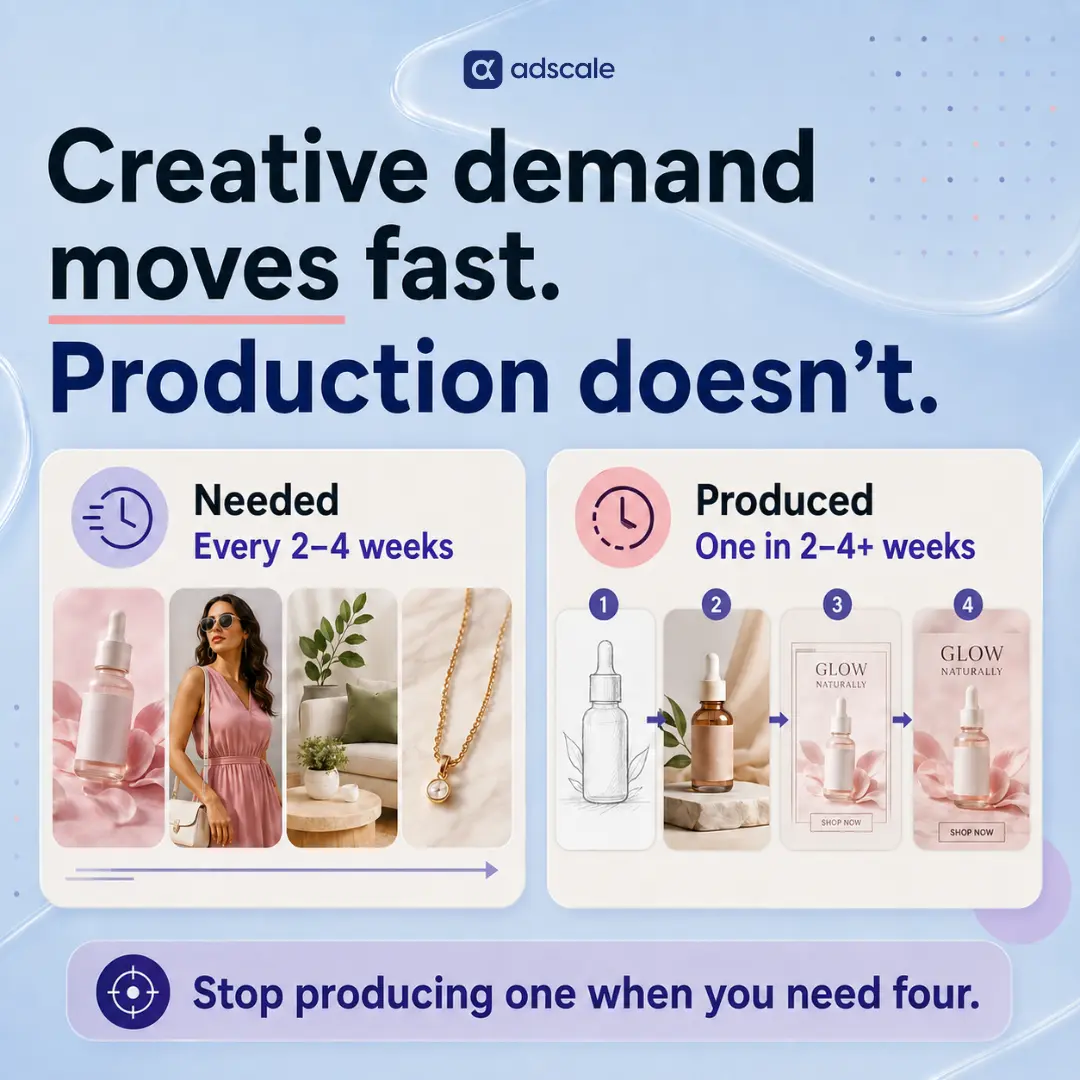
In short: creative production has become ecommerce advertising’s biggest bottleneck. Meta’s Andromeda system now needs a genuinely new creative concept every two to four weeks to keep performing. Most in-house or agency production cycles haven’t sped up to match. They still take two to four weeks or longer to turn one idea into a single finished, ad-ready asset. Those two clocks used to have slack between them. Now they don’t, and the gap is where performance quietly leaks out.
The strategic advice to “diversify your creative” is easy to give and hard to execute. A genuinely new concept is not a new headline on the same shot. Producing one still takes a designer, sometimes a photoshoot, and a revision round. For a small or mid-size ecommerce team, that cycle often runs two to four weeks per concept. That’s true even when things are going well. That’s not a strategy gap. It’s a throughput gap. That’s the real story behind why creative has quietly become the most constrained resource in ecommerce advertising.
Key Takeaways#
- Meta’s Andromeda system, live globally since October 2025, evaluates creative content directly. It groups visually similar variations into a single retrieval entity. Cosmetic refreshes don’t reset fatigue the way a genuinely new concept does.
- An analysis by Confect, covering 3,014 ecommerce advertisers through the 2025 rollout, found effective creative lifespan compressing fast. It fell from roughly six to eight weeks down to two to four weeks. Most production cycles still run on the old, slower timeline.
- A controlled test found a single ad set running 25 genuinely distinct creatives beat a fragmented five-ad-set structure. It produced 17% more conversions at 16% lower cost. That’s evidence concept volume decides outcomes more than launch frequency does.
- Meta needs new concepts faster than most teams can produce them. That’s a production problem, not an ideas problem. It’s why AI-assisted creative generation has moved from a nice-to-have into working infrastructure for lean ecommerce teams.
- AdScale’s own creative tool is one example of closing that gap. It generates ad-ready images from a store’s live product and sales data. That happens inside the same workflow already used to manage targeting and budget.
Why Meta’s Andromeda Update Sped Up Ad Creative Fatigue#
Before Andromeda, Meta’s retrieval stage narrowed tens of millions of ad candidates down to a few thousand real contenders. It relied heavily on rule-based logic and the audience parameters an advertiser set: interests, lookalikes, retargeting lists. Creative mattered, but targeting carried most of the weight. The Meta Andromeda update breakdown on this site covers that shift in more detail.
Andromeda replaced that stage with deep neural networks that read the creative content directly. Interest targeting still exists, but it now behaves more like a soft suggestion than a hard filter. The practical effect is that creative now does the job targeting used to share with it. It also does that job on a shorter clock. The same system that rewards genuine diversity also groups visually or conceptually similar variations into a single entity. Ten near-identical versions of one ad still register as one shot at the auction, not ten.
That’s the part most refresh advice skips. A brand can update creative every two weeks and still be feeding Andromeda the same entity over and over. That happens when the update is a new headline or a recolored background rather than a new concept. The algorithm’s clock sped up. For most teams, the production clock that turns an idea into a finished, distinct, ad-ready asset did not.
The Data Behind the Ad Creative Production Gap#
The clearest picture of how much Andromeda changed the pace comes from a study Confect ran, a Meta catalog-ads platform. It covered more than $834 million in tracked ad spend and 115.7 billion impressions. Effective creative lifespan compressed hard, from six to eight weeks pre-Andromeda down to two to four weeks post-rollout. The system’s precision matching finds the best-fit audience for a concept quickly. Then it exhausts that audience just as fast.
The same study pointed to a controlled test, run by agency Five Nine Strategy, isolating genuine diversity from simple volume. A single ad set running 25 meaningfully different creatives produced 17% more conversions at 16% lower cost. That beat a traditional structure spread across five separate ad sets. Furniture retailer Bed Kingdom, working with agency Connective3, cut cost per acquisition by 58%. They ran multiple genuinely distinct catalog ad variants at once, instead of one polished template stretched across the whole feed.
Meta’s own reporting points the same direction. Advertisers who adopted Advantage+ creative’s automated variation features saw a 22% lift in ROAS, according to Meta’s engineering team. The platform is not neutral on this question. It is actively rewarding the advertisers who can keep genuinely new concepts flowing. Through entity clustering, it penalizes the ones who can’t.
The Real Bottleneck Is Production Throughput, Not Creative Ideas#
Most ecommerce marketers don’t lack a point of view on what their next ad should say. What they lack is a way to turn ideas into finished assets fast enough. A price-led angle, a lifestyle scene, a social-proof design, an unboxing clip, a plain product shot: five different concepts. Each one still has to become a finished, ad-ready asset before its moment passes.
That’s a useful way to separate a real refresh from a cosmetic one. Would this new asset change the hook, the format, or the proof point? Or is it the same concept in a different outfit? Only the first kind resets fatigue under Andromeda’s clustering. The second kind is where most production time quietly goes. A small revision is faster to execute than an entirely new shoot. But the algorithm treats it as nothing new at all.
Closing the Ad Creative Production Gap With AI-Assisted Generation#
A growing category of tools addresses this directly. They generate multiple ad-ready creative concepts from a store’s own product and sales data. There’s no full design cycle behind each one. AdScale built one of these directly into its advertising platform, called Agentic Ad Creatives. It’s a useful concrete example of what closing the gap actually looks like in practice.
The tool connects to a store’s existing data through what AdScale calls Smart Store Sync. Trending products, active promotions, seasonal patterns, and current inventory feed directly into what gets generated. That way, a new concept reflects what’s actually happening in the business, rather than a generic template. Building a new ad starts with three questions: which product, what’s the offer, what’s the vibe. That replaces a prompt-engineering exercise. The resulting images are production-ready for feed, story, and carousel formats. Adjustments happen conversationally: “make it feel more summery,” “put more focus on the product.” There’s no full revision brief needed. The tool sits inside the same platform used to manage targeting and budget. That means a finished creative publishes into an existing campaign, not a new workflow built from a downloaded file.
None of this replaces a brand’s judgment about what its ads should say. What it removes is the delay between deciding on a concept and having it live. That’s the specific delay Andromeda’s shortened attention span no longer tolerates. Readers who want the full walkthrough can find it in the Agentic Ad Creatives feature breakdown.
How to Fix the Ad Creative Production Bottleneck on Your Account#
- Time your current concept-to-launch cycle honestly. From idea approval to going live, how many days does it actually take today?
- Compare that number to the two-to-four-week decay window. If concept-to-launch takes longer than the window itself, the account is structurally behind before a single ad goes live.
- Separate ideas from shipped assets. Count only concepts that would pass the change-the-hook-or-format test. A headline swap or recolor doesn’t count, no matter how it feels on the production calendar.
- Pilot AI-assisted generation on the lowest-stakes format first. Static feed ads are a lower-risk starting point than a full video campaign. They surface whether the workflow fits before wider rollout.
- Feed the tool real store signals, not generic prompts. Bestsellers, live promotions, and current inventory produce more relevant creative than a blank prompt box ever will.
- Keep a human check on brand voice before anything publishes. Faster production is only useful if what ships still sounds like the brand.
- Track concepts shipped per month as the real KPI. Hours saved is a nice side effect. Genuinely new concepts in market is the number that actually predicts whether the account keeps up.
Frequently Asked Questions#
Meta’s Andromeda update compressed effective creative lifespan from six to eight weeks down to two to four weeks. Most production cycles, designer time, photoshoots, revision rounds, still run on the older, slower timeline. The gap between those two speeds is what creates the bottleneck.
Performance depends more on whether a concept is genuinely distinct than on how it was produced. Meta’s own reporting found a 22% ROAS increase from advertisers using AI-driven creative variation features. That suggests the platform rewards relevant variety, regardless of production method.
Tools built into an advertising platform, like AdScale’s Agentic Ad Creatives, pull directly from a store’s live data. Outputs reflect what’s currently selling, rather than a generic prompt. Standalone image tools have no connection to that live store context.
For static and video ads, yes, that’s the window where independent data shows performance measurably declining under Andromeda. Catalog and dynamic product ads have more breathing room, since the product feed itself supplies some rotation. The design template around them still needs refreshing periodically.
No. It removes the production delay between deciding on a concept and having it live. It doesn’t remove the judgment about what the concept should be. A brand’s point of view on hooks, offers, and audiences still has to come from the team. The tool just executes it faster.
The Ads That Keep Up#
The old competitive edge in Meta advertising was a sharper audience list. The new one is a shorter distance between having an idea and having it live. Andromeda didn’t punish brands for lacking creativity. It punished the gap between deciding what to say and actually saying it.
Close that gap, and the refresh question mostly answers itself.
Keep Learning#
- Agentic Ad Creatives: The Ad Creative AI Generator Built Into Your AdScale Platform. The full feature walkthrough. See how Smart Store Sync, the No-Prompt Wizard, and one-click publishing work together.
- Meta Andromeda Update: New Creative Strategy for Facebook and Instagram Ads. A broader look at everything Andromeda changed across targeting, creative, and campaign structure.
- How Many Ad Creatives Per Ad Set? The companion question to production speed. How many active creatives can an ad set actually carry?
- Clothing Industry Ad Benchmarks: Google vs. Meta Across 100M+ Orders. Where Meta and Google differ on CPA and ROAS for apparel advertisers specifically.


 Shopify
  WooCommerce
  PrestaShop
  Magento
  BigCommerce
  Opencart
  Wix
Wix 



 ,
,