



AdScale vs Blend AI (2026): Which One Fits Your eCommerce Store?
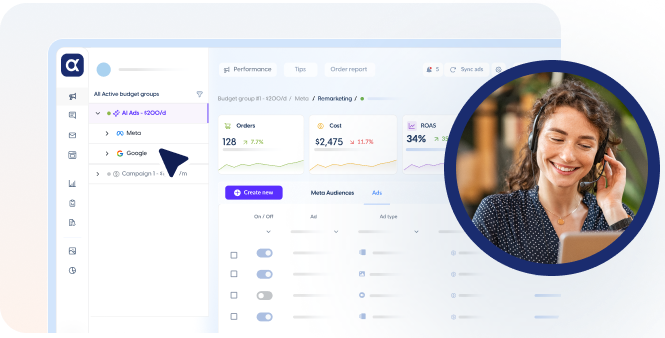
AdScale builds and optimizes Google and Meta campaigns from store data, with email, SMS and analytics in the same platform.
Blend AI is an ecommerce advertising platform that deploys campaigns across Meta, Google, TikTok, YouTube and Microsoft Ads, with AI budget allocation and a first-party pixel.
AdScale fits stores wanting ads and messaging together; Blend fits brands wanting more ad channels.
Connects to your store, uses your first-party data, and builds, runs and optimizes Google and Meta campaigns, with budgets managed across both channels.
- Google (Search, Performance Max, Display) and Meta campaigns
- Built from your first-party store data
- Audience targeting with segments, lookalikes and personas
- Cross-channel budget and bid optimization
- Email, SMS and business analytics in the same platform

Build a campaign once and deploy it across Meta, Google, TikTok, YouTube and Microsoft Ads. AI allocates budget, builds audiences from a first-party pixel and analyzes creative.
- Meta, Google, TikTok, YouTube and Microsoft Ads from one campaign flow
- AI budget allocation across channels and creatives
- First-party pixel and server-side tracking
- Creative analysis with AI-built static image variants
- Runs inside your own ad accounts
Side by side
Feature-by-feature comparison
Tap any row to see why it matters for a store.
Blend AI
Facebook and InstagramBoth
Included
Included
Google campaignsDifferent types
Search, Performance Max and Display
Search, Shopping, Display and Video (YouTube)
TikTokEdge: Blend AI
Not Supported
TikTok Display and Video
Microsoft AdsEdge: Blend AI
Not Supported
Microsoft Ads Shopping
Campaign setupBoth
Automated campaign creation
Build once and deploy across channels
Cross-channel budget optimizationBoth
Budgets managed across Google and Meta
AI shifts budget toward top-performing channels and creatives
AI optimizationBoth
24/7 automated AI optimization
Analyzes performance across channels and acts on budget, creative and results
AI audiencesBoth
Segments, lookalikes, retargeting, personas
Automated Audiences built from a first-party pixel
First-party data and trackingBoth
Built from your first-party store data
Proprietary pixel for first-party data and server-side tracking
AI image and video adsEdge: AdScale
Magic video ads, plus agentic video and image creation
Three AI-built static image variants; AI video creation not documented
Based on public product documentation as of Sep 2026. Spotted something out of date? Tell us.
Pros & cons
The trade-offs in one view
Pros
- Builds and runs Google and Meta campaigns from store data
- Uses your first-party store data
- Email, SMS and business analytics in one platform
- Optional managed tier with a dedicated account manager
Cons
- TikTok, Microsoft Ads and YouTube campaigns not documented
Blend AIPros
- Meta, Google, TikTok, YouTube and Microsoft Ads from one campaign flow
- First-party pixel and server-side tracking
- Creative analysis suggests the next ad to run
- Runs inside your own ad accounts, and everything stays with you if you switch it off
Cons
- Email and SMS not documented
Same task, two approaches
Launching ads for a new product
How the work splits between you and the tool in each case.
- Connect your storeAdScale works with seven store platforms
- AdScale builds Google and Meta campaigns from store dataAutomated campaign creation for Search, Performance Max, Display, Facebook and Instagram
- AI copy and video are generatedMagic AI copy and Magic video ads
- Budget and bids are optimized across channels24/7 automated AI optimization
- Connect your store and ad accountsInstall from Shopify or connect WooCommerce, then link your ad accounts
- Build once and deployOne campaign goes out across Meta, Google, TikTok, YouTube and Microsoft
- AI allocates budget and builds audiencesMoves spend across channel, creative and audience; a first-party pixel builds audiences
- Creative analysis suggests the next adReads what already works in your ad account
AdScale suits online stores that want Google and Meta campaigns built and run from store data, with email, SMS and analytics in the same platform. Blend AI suits ecommerce brands that already run paid ads and want one campaign flow across Meta, Google, TikTok and Microsoft Ads with a first-party pixel.
Source: AdScale, "AdScale vs Blend AI (2026)", adscale.com/compare/adscale-vs-blend-ai/
We build AdScale, so this page focuses on where AdScale fits and where the two products differ. It uses each vendor's public product pages, pricing pages, help articles and app-store or review-platform listings, checked on October 15, 2026 (AdScale) and October 21, 2026 (Blend AI).
Changelog: October 2026: first version, built from public documentation.
FAQ
AdScale vs Blend AI: FAQ
What does AdScale do?
AdScale automates campaign creation for Google (Search, Performance Max, Display), Facebook and Instagram, 24/7 AI optimization of bids and budgets, and business analytics, SMS and email, all built on your first-party store data.
Which store platforms does AdScale work with?
AdScale works with Shopify, WooCommerce, PrestaShop, Magento, BigCommerce, OpenCart and Wix.
What is Blend AI and who is it for?
Blend AI is an ecommerce advertising platform, with its company based in Sydney, Australia and its Shopify app launched on January 21, 2021. Its pricing page says it is built for brands that have validated their product and already run paid ads.
Which ad channels and campaign types does Blend support?
Its help center lists Google Search, Shopping, Display and Video (YouTube), Meta Catalog, Display and Video, Microsoft Ads Shopping, and TikTok Display and Video, covering text, image, product and video ads.
How does Blend use first-party data and tracking?
Blend uses a proprietary pixel that tracks customer behavior, builds audiences automatically and syncs them across channels, with server-side tracking behind its reporting. Its Pulse Data add-on adds Klaviyo event integration.
Does AdScale use my first-party data and audience segments?
Yes. AdScale uses your first-party store data, and it advertises to customer and product segments. Its segments tool adjusts which segments are targeted using time-of-day and engagement signals.




Stop guessing your ROAS target.
Connect your store and AdScale sets break-even and target ROAS per product, then optimizes Google and Meta toward profit.

 Shopify
 WooCommerce
 PrestaShop
 Magento
 BigCommerce
 Opencart
 Wix




 ,
