




AdScale vs Google Performance Max (2026): Which One Fits Your eCommerce Store?
AdScale is an AI advertising platform that builds and runs Google and Meta campaigns from your store data.
Performance Max is Google’s own goal-based campaign type covering Google’s ad inventory, with no startup costs.
They overlap rather than compete head-on: AdScale fits stores wanting Google and Meta handled together; native Performance Max fits advertisers happy to manage Google directly.
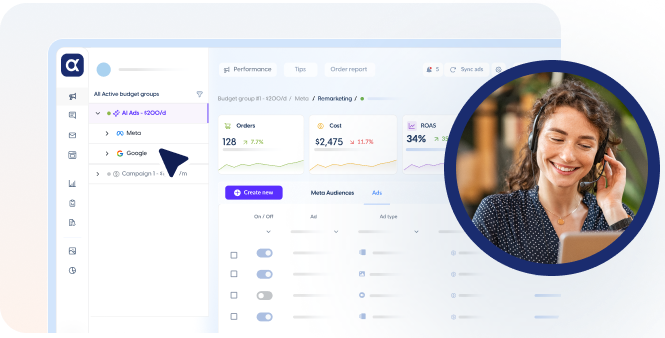
Connects to your store, uses your first-party data, and builds, runs and optimizes Google and Meta campaigns, with budgets managed across both channels.
- Google (Search, Performance Max, Display) and Meta campaigns
- Built from your first-party store data
- Audience targeting with segments, lookalikes and personas
- Cross-channel budget and bid optimization
- Email, SMS and business analytics in the same platform

You provide text, images, videos and feeds, and Google AI combines them into ads. It can also generate additional text and video assets.
- One campaign across YouTube, Display, Search, Discover, Gmail and Maps
- Bidding goals with an optional ROAS or CPA target
- Accepts product data feeds
- No startup costs; pay for performance
Side by side
Feature-by-feature comparison
Tap any row to see why it matters for a store.
Google Performance Max
Google inventoryBoth
Search, Performance Max, Display
One campaign across Google channels
Facebook and InstagramEdge: AdScale
AI automated
Google's description lists only Google inventory
Cross-channel budget optimizationEdge: AdScale
Real time, Google ↔ Meta
Across Google channels
Campaign setupEdge: AdScale
Automated campaign creation
You provide assets, goals and feeds, and Google AI assembles the ads
AI ad copy and videoTie
"Magic AI copy", agentic video and image creation
Can generate additional text assets
Product feed driven adsTie
Live store-to-ads sync
Data feeds are an input
Channel-level reportingEdge: AdScale
Cross-channel analytics
Channel reporting added in 2025
Based on public product documentation as of Sep 2026. Spotted something out of date? Tell us.
Pros & cons
The trade-offs in one view
Pros
- Builds and runs Google and Meta campaigns from store data
- Uses your first-party store data
- Email, SMS and business analytics in one platform
- Optional managed tier with a dedicated account manager
Cons
- Subscription by ad-spend tier ($169 on Shopify) plus ad spend, while Google states Performance Max has no startup costs
Google Performance MaxPros
- One campaign across YouTube, Display, Search, Discover, Gmail and Maps
- Can generate additional text and video assets
- Accepts product data feeds as inputs
- No startup costs; you pay for performance
Cons
- Facebook and Instagram not covered; Google's description lists only Google inventory
- Trade press has called it a "black box"; Google added channel reporting in 2025
- Control remains largely with Google's AI
Same task, two approaches
Launching ads for a new product
How the work splits between you and the tool in each case.
- Connect your storeAdScale works with seven store platforms
- AdScale builds Google and Meta campaigns from store dataAutomated campaign creation for Search, Performance Max, Display, Facebook and Instagram
- AI copy and video are generatedMagic AI copy and Magic video ads
- Budget and bids are optimized across channels24/7 automated AI optimization
- Gather your assetsText, images, videos and product feeds
- Set your goal and biddingBidding goals with an optional ROAS or CPA target
- Google AI assembles the adsCombines your assets across Google's channels and can generate extra text and video
- Review channel reportingOverriding placements turns AChannel reporting was added in 2025dvantage+ off
AdScale suits online stores that want Google and Meta campaigns built and run from store data. Google Performance Max suits advertisers who are comfortable setting up Google Ads campaigns themselves and want one campaign across Google's inventory.
Source: AdScale, "AdScale vs Google Performance Max (2026)", adscale.com/compare/adscale-vs-google-performance-max/
We build AdScale, so this page focuses on where AdScale fits and where the two products differ. It uses each vendor's public product pages, pricing pages, help articles and app-store or review-platform listings, checked on October 15, 2026.
Changelog: October 2026: first version, built from public documentation.
FAQ
AdScale vs Google Performance Max: FAQ
Is Google Performance Max an alternative to AdScale?
Partly. Performance Max is Google's native campaign type, and AdScale supports Performance Max among the campaigns it creates, along with Meta campaigns.
Does Performance Max run on Facebook or Instagram?
No. Google's description lists only Google inventory: YouTube, Display, Search, Discover, Gmail and Maps.
Does Performance Max cost extra or have a free trial?
Google states there are no startup costs and you pay for performance, billed by clicks or CPM depending on channel. We did not find a free trial.
Is Performance Max a black box?
Trade press has long used that term. Google announced added channel reporting, full search terms and asset metrics on 2025-04-30.
What does AdScale do?
AdScale automates campaign creation for Google (Search, Performance Max, Display), Facebook and Instagram, 24/7 AI optimization of bids and budgets, and business analytics, SMS and email, all built on your first-party store data.
Does AdScale create Performance Max campaigns?
Yes. AdScale builds Google campaigns across Search, Performance Max and Display, plus Facebook and Instagram campaigns, from your store data.
Which store platforms does AdScale work with?
AdScale works with Shopify, WooCommerce, PrestaShop, Magento, BigCommerce, OpenCart and Wix.
How much does AdScale cost?
AdScale charges a fixed subscription plus usage charges based on your ad-spend tier. On the Shopify App Store, plans were $169, $249 and $329 a month by ad-spend cap (up to $1,000, $2,000 and $3,000) when we checked on October 15, 2026, and there is a 7-day free trial.
Stop guessing your ROAS target.
Connect your store and AdScale sets break-even and target ROAS per product, then optimizes Google and Meta toward profit.

 Shopify
 WooCommerce
 PrestaShop
 Magento
 BigCommerce
 Opencart
 Wix





 ,
