



AdScale vs Smartly.io: Which AI Ads Platform Fits Your eCommerce Business?
AdScale is an AI advertising platform that builds and runs Google and Meta campaigns from your store data. Smartly.io is an enterprise advertising platform that combines creative production, media automation, and team workflows across multiple channels. Store owners who want store-driven Google and Meta automation should choose AdScale. Enterprise teams managing large creative volumes and complex advertising operations should choose Smartly.io.
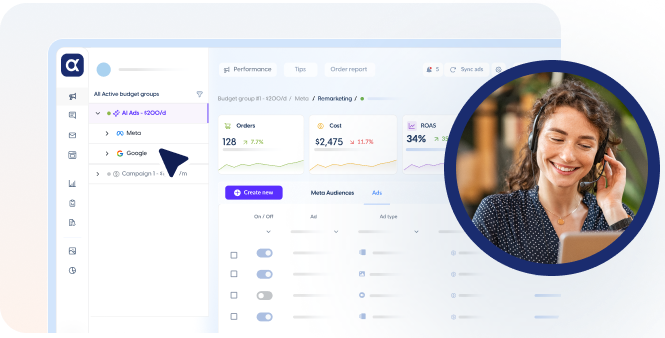
Connects to your store, finds your buying personas, and builds, runs and rebalances Google and Meta campaigns automatically.
- Google + Meta with live budget shifting
- First-party store data and personas
- Creative and copy per persona

Smartly.io combines AI creative production, campaign automation, and reporting across multiple advertising channels. It helps large teams scale ad variations, coordinate workflows, and optimize campaigns.
- AI-powered image and video creative production
- Dynamic templates for scaling ad variations
- Campaign management and media optimization
- Team collaboration and approval workflows
- Cross-channel reporting and creative insights
Side by side
Feature-by-feature comparison
Tap any row to see why it matters for a store.
Smartly
Meta (Facebook & Instagram)Both support
AI campaign creation and optimization
Campaign automation and optimization
Google AdsBoth, different coverage
AI campaign creation and optimization
Selected campaign types; Performance Max in beta
Microsoft AdsSame
Not supported
Not listed among supported platforms
Cross-channel budget shiftingBoth support
Real-time allocation across Google and Meta
Automated allocation across supported channels
Native store integrationsDifferent setup
Shopify, WooCommerce, Magento, BigCommerce, and more
Catalog and feed connections; native store connectors require confirmation
Persona discoveryDifferent approaches
Finds customer personas using store data
Audience activation supported; equivalent store-based persona discovery unconfirmed
Competitor benchmarkingDifferent focus
Store KPIs compared with similar merchants
Equivalent merchant benchmarking unconfirmed
Automation styleBoth, different workflows
Store-driven AI campaign creation and ongoing optimization
AI optimization, feed automation, and configurable workflows
Ad copy & creative generationBoth, different strengths
AI copy and creatives informed by products and personas
AI-assisted creative generation, templates, and localization
Bulk edits & scriptsBoth support bulk actions
Bulk ad editing; custom scripting unconfirmed
Bulk campaign actions and automated workflows; custom scripting unconfirmed
ReportingDifferent strengths
Unified Google, Meta, and eCommerce BI
Cross-channel campaign and creative insights
Account auditsDifferent scope
ShopScore analysis and a separate marketing audit tool
Campaign QA tools; dedicated account audit unconfirmed
Email marketingDifferent scope
Email campaigns and automation available
Native email campaign sending not documented
Based on public product documentation as of Sep 2026. Spotted something out of date? Tell us.
Pros & cons
The trade-offs in one view
Pros
- Connects directly to your eCommerce store
- Uses store data to discover customer personas
- Generates AI creatives and automates campaign optimization
- Benchmarks performance against similar merchants
Cons
- Paid advertising limited to Google and Meta
- Specialized for eCommerce, with less relevance for other business models
SmartlyPros
- Scales image and video creatives across markets
- Supports advertising beyond Google and Meta
- Automates cross-channel budget allocation
- Supports first-party data and CRM audience activation
Cons
- Requires configuration of templates, feeds, and campaign workflows
- Google campaign coverage varies; Performance Max is currently in beta
Same task, two approaches
Launching ads for a new product
How the work splits between you and the tool in each case.
- Select the product from your connected storeUse your synced catalog and store data
- Generate audiences, copy, and creativesAI uses product and customer insights to inform campaigns
- Review and launch on Google and MetaSet goals and budgets, then approve or edit the ads
- Let AI optimize bids and budgetsAdScale adjusts allocation across Google and Meta based on performance.
- Connect your product feed and ad accountsPrepare product information for campaign automation
- Configure creative templatesGenerate variations for your formats, channels, and markets
- Configure and launch campaignsSet audiences, budgets, and goals across supported channels
- Activate automated budget optimizationSmartly reallocates spend against your selected goals; your team reviews results
AdScale is the better fit for eCommerce stores that want AI to create and optimize Google and Meta ads using store data, while Smartly.io is the better fit for teams managing large-scale creative production and advertising across multiple channels and markets.
AdScale, "AdScale vs Smartly.io (2026)", adscale.com/compare/adscale-vs-Smartly/
We build AdScale, so we tell you where Optmyzr is stronger. This comparison uses each vendor's public documentation, pricing pages and product demos, reviewed on Sep 29, 2026. We review it quarterly.
Sep 2026: added Microsoft Ads row, refreshed screenshots.
FAQ
AdScale vs Smartly.io: FAQ
Which is better for Shopify and eCommerce stores?
AdScale is the more direct fit for stores that want AI to create and optimize Google and Meta campaigns using customer, order, and product data. Smartly.io suits brands with broader channel requirements and large-scale creative operations.
Does Smartly.io automate Google and Meta ads?
Yes. Smartly.io supports campaign automation and budget optimization across Meta and supported Google campaign types. AdScale also automates both channels, with a workflow built around connected eCommerce store data.
Do both platforms use first-party data?
Yes. AdScale uses connected store data to build customer personas and inform campaigns. Smartly.io supports first-party business data and CRM audience activation through integrations. The difference is how that data connects to your advertising workflow.
Stop guessing your ROAS target.
Connect your store and AdScale sets break-even and target ROAS per product, then optimizes Google and Meta toward profit.

 Shopify
 WooCommerce
 PrestaShop
 Magento
 BigCommerce
 Opencart
 Wix




 ,
