


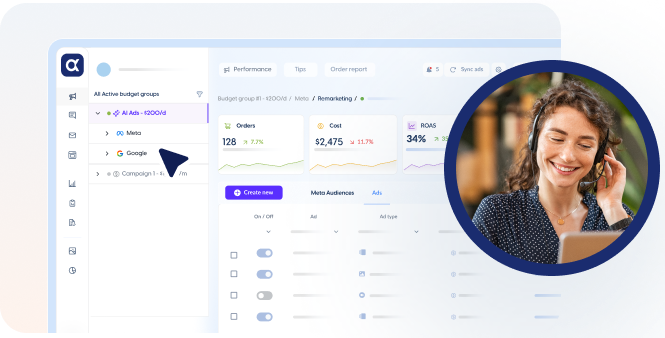




AdScale and AdRoll both support eCommerce growth, but they operate in different layers of the marketing stack.
AdScale is an AI-powered advertising platform purpose-built for eCommerce merchants, using deep store data, persona intelligence, and real-time cross-channel optimization across Google and Meta.
AdRoll is a retargeting and multichannel marketing platform focused on display advertising, social retargeting, and lifecycle marketing, including email.
This comparison explains how the platforms differ and when each one should be used.
Overview of Both Platforms
What is AdScale
AdScale is an AI-powered advertising platform built specifically for eCommerce merchants.
It connects directly to Shopify, WooCommerce, Magento, and additional eCommerce platforms to analyze the entire store dataset, including:
- Purchase history
- Customer behavior
- Product performance
- Retention patterns
- AOV and conversion metrics
What makes AdScale unique:
- Store Data Analysis (First-Party Data): Reads and analyzes the full eCommerce dataset.
- Benchmarking vs Competitors: Compares store performance across dozens of KPIs against similar merchants.
- Persona Discovery: Identifies buying personas and uncovers hidden personas not yet reached.
- Persona-Based Campaigns:
- Persona-specific targeting
- Persona-tailored ad copy
- Persona-specific creatives
- Cross-Channel Optimization (Google + Meta): Automatically shifts budgets and optimizes performance between Google and Meta in real time based on revenue and ROAS.
In short, AdScale uses store data to create accurate targeting, creatives, and optimization, fully automated.
What is AdRoll
AdRoll is a retargeting and multichannel marketing platform designed to help eCommerce brands re-engage visitors and customers.
Its core focus areas include:
- Display retargeting across the web
- Social retargeting placements
- Email marketing and lifecycle campaigns
- Audience segmentation based on onsite behavior
AdRoll is designed to support remarketing, retention, and post-click engagement rather than full acquisition campaign automation.
Summary of Key Differences
- AdScale focuses on eCommerce advertising automation, persona intelligence, store-data optimization, and real-time Google and Meta management.
- AdRoll focuses on retargeting, display advertising, social remarketing, and lifecycle email marketing.
- AdScale builds, optimizes, and scales Google and Meta ad campaigns.
- AdRoll re-engages visitors and customers through ads and emails across multiple channels.
- AdScale uses first-party store data and personas to drive acquisition performance.
- AdRoll uses behavioral and engagement data to power remarketing.
These platforms serve different roles in the eCommerce funnel.
Feature Comparison Table
Core Differences Table
| Feature | AdScale | AdRoll |
|---|---|---|
| Primary purpose | eCommerce ad automation | Retargeting and lifecycle marketing |
| Google Ads automation | Yes | No |
| Meta Ads automation | Yes | No |
| Cross-channel Google + Meta optimization | Yes | No |
| Display retargeting | Limited | Advanced |
| Social retargeting | Via Meta | Yes |
| Email marketing | No | Yes |
| Audience builder | First-party store data + personas + pixel signals | Behavioral and engagement-based |
| Benchmarking vs competitors | Yes | No |
| Reporting | Unified Google + Meta + eCommerce BI | Multichannel engagement reporting |
| Ecommerce integrations | Shopify, WooCommerce, Magento + more | Shopify, WooCommerce, Magento, BigCommerce |
| Best for | Scaling acquisition ads | Retargeting and retention |
AdScale Overview
AdScale is designed for eCommerce brands that want true data-driven advertising automation.
The platform analyzes store performance across customer journeys, product engagement, retention behavior, competitive benchmarks, and revenue patterns.
Based on these insights, AdScale automatically builds persona-based campaigns with:
- Persona-specific audience targeting
- Tailored messaging and ad copy
- Creative variations aligned to persona motivations
- Product-level decision making driven by store performance
AdScale then performs real-time optimization between Google and Meta, continuously shifting budgets and allocating spend where it generates the highest return.
AdRoll Overview
AdRoll focuses on remarketing and customer engagement after a user has interacted with a brand.
It helps eCommerce brands:
- Retarget site visitors with display and social ads
- Recover abandoned carts
- Run lifecycle and promotional email campaigns
- Segment audiences based on browsing and purchase behavior
AdRoll does not manage or optimize full Google or Meta acquisition campaigns end to end and does not perform cross-channel ad budget optimization.
Detailed Comparison
Primary Purpose
AdScale
Automates the creation and optimization of Google and Meta ads for eCommerce growth.
AdRoll
Improves retargeting, email engagement, and customer retention.
Advertising Automation
AdScale
Full-funnel automation including store data analysis, persona discovery, persona-based campaign creation, dynamic creatives, and real-time cross-channel optimization.
AdRoll
Does not automate acquisition campaigns. Focuses on retargeting and lifecycle messaging.
Retargeting
AdScale
Includes retargeting within Google and Meta campaigns as part of a broader acquisition and lifecycle strategy.
AdRoll
Specializes in retargeting across display networks, social placements, and email.
Email and Lifecycle Marketing
AdScale
Does not provide email or lifecycle marketing tools.
AdRoll
Includes email automation, newsletters, and lifecycle flows.
Budget Control
AdScale
Automatically reallocates budgets between Google and Meta based on revenue, ROAS, and persona performance.
AdRoll
Uses manual or rule-based controls for retargeting and email campaigns.
Creative Tools
AdScale
Generates creatives and messaging tailored to each persona and continuously optimizes them based on performance.
AdRoll
Provides creative templates for display ads and emails.
Audience Management
AdScale
Builds eCommerce audiences using:
- First-party store data
- Customer personas
- Product interests
- Purchase behavior
- Lifecycle patterns
- Pixel signals
AdRoll
Builds audiences based on onsite behavior, engagement, and customer interactions.
Reporting
AdScale
Unified BI reporting across Google, Meta, and ecommerce store performance, including benchmarking vs competitors.
AdRoll
Reporting focused on engagement, retargeting performance, and email metrics.
Which Platform Fits eCommerce Brands Best
Choose AdScale if you want:
- Automated advertising with minimal manual work
- True first-party data activation
- Store benchmarking to identify growth opportunities
- Customer persona discovery
- Persona-based campaigns with tailored targeting, copy, and creatives
- Continuous optimization across Google and Meta
Choose AdRoll if you want:
- Retargeting and remarketing
- Abandoned cart recovery
- Email marketing and lifecycle flows
- Post-click engagement and retention
Many eCommerce brands use both platforms for different stages of the funnel.
Summary
AdScale automates acquisition advertising across Google and Meta using store data, persona intelligence, and real-time optimization.
AdRoll focuses on retargeting, email automation, and customer engagement.
AdScale scales ads.
AdRoll improves retention.
FAQ Section AdScale vs AdRoll
Yes. AdScale automates Google and Meta ad campaigns. AdRoll does not manage acquisition advertising.
Yes. AdRoll includes email automation and lifecycle marketing.
No. AdScale focuses on acquisition advertising, not email or dedicated retargeting platforms.
No. AdRoll does not automate Google or Meta acquisition campaigns.
Many Shopify brands use AdScale for acquisition and AdRoll for retention and remarketing.

 Shopify
  WooCommerce
  PrestaShop
  Magento
  BigCommerce
  Opencart
  Wix
Wix 




 ,
,