


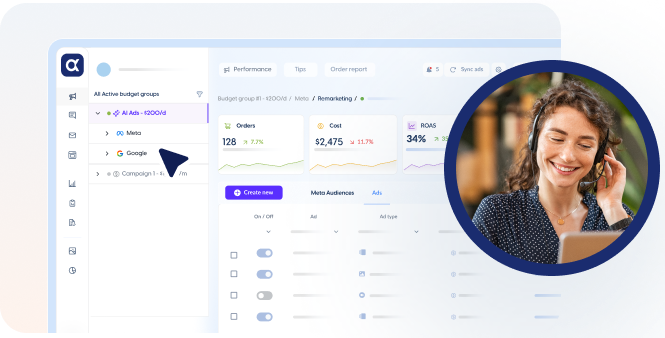





Google and Meta Automation for eCommerce Isn’t Optional Anymore – It’s the Operating System for Scale
Manual campaign management can’t compete in today’s auction-driven ad landscape. The speed of change on Google and Meta – from creative fatigue to bid fluctuations and intent shifts – outpaces human reaction time. If you’re still adjusting budgets manually, you’re not optimizing – you’re just chasing performance drops. To scale eCommerce profitably, brands need automation that not only keeps up, but stays ahead. That’s where unified, AI-driven systems come in.
This guide is your full strategic and tactical playbook for automating eCommerce advertising across Google and Meta – not in silos, but as a single, coordinated growth engine. You’ll learn how platform automation really works, what it demands from your data and creative, and how to layer tools like Adscale on top to drive efficient, predictable, cross-channel performance.
1. Why Automation Matters in Google and Meta Ads
Automation Isn’t Optional – It’s the Only Way to Win in Real-Time Auctions
Google and Meta have moved past manual levers. They reward data-rich advertisers who let their AI systems work with real-time signals. Trying to outsmart the system manually just slows you down and burns budget.
Google and Meta want advertisers to provide clean data, strong creative, and enough conversion volume for machines to learn. Once those conditions exist, the platforms take over most day to day optimization.
1.1 Platform automation is the new standard
Both Google and Meta rely on machine learning for the vast majority of decisions that influence ad performance.
On Google:
- Automated bidding strategies select auction entry points
- Performance Max chooses placements, audiences, and inventory
- Dynamic signals inform impression delivery
On Meta:
- Advantage+ audiences and placements determine delivery paths
- Conversion based optimization identifies high intent users
- Machine learning adapts to creative, audiences, and behaviors
Google and Meta no longer expect advertisers to micromanage. They expect advertisers to set accurate conversion signals, provide diversified creative, and allow automation to find the best opportunities.
1.2 Manual optimization cannot keep pace with auction complexity
Auction behavior changes too rapidly for human operators to match. Costs shift by the minute. Audience composition fluctuates based on real time behaviors. Creative engagement patterns evolve daily. With thousands of micro signals influencing every auction, manual optimization introduces delay and inefficiency. Manual campaign management can’t compete in today’s auction-driven ad landscape.
This explains why manual bid strategies consistently underperform automated bidding across nearly all verticals and why creative rotation based on manual triggers leads to performance decay.
1.3 Multi channel automation is required for predictable scaling
Most eCommerce brands treat Google and Meta as separate environments. This produces fragmented decisions, misaligned funnels, and budget allocation problems. When Google and Meta automation operate independently, each platform optimizes for its own success, not the success of the overall store.
This misalignment causes:
- Overspending on one channel
- Underspending on the other
- Gaps in top, mid, and bottom funnel coverage
- Unstable performance cycles
- Difficulty scaling profitably
Unified automation solves these issues by ensuring that both platforms operate under shared logic, shared goals, and shared data inputs.
2. The Building Blocks of Google Automation
Google’s automation stack is built on bidding, creative, and product data. Google evaluates millions of signals per second to determine how to deliver ads. When structured correctly, Google’s automation produces powerful scaling outcomes. When structured poorly, the system receives conflicting signals and underperforms.
2.1 Automated bidding
Google offers automated bidding strategies that optimize toward specific outcomes:
- Maximize conversions
- Maximize conversion value
- Target CPA
- Target ROAS
These strategies evaluate signals such as device type, location, query intent, audience behavior, shopping attributes, product feed data, and historical conversion patterns. The more accurate and stable the conversion tracking, the more effective these automated bidding systems become.
2.2 Performance Max as Google’s unified automation system
Performance Max is Google’s most advanced automated system. It combines Search, Shopping, Display, YouTube, and Discovery into one campaign that Google optimizes based on available assets and signals.
Performance Max determines:
- Which channels to use
- Which audiences to deliver to
- How to distribute budget
- How to bid in each auction
It works best when:
- Conversion tracking is accurate and stable
- Product feed data is complete
- Asset groups contain diverse creative
- Sufficient daily conversion volume exists
Performance Max is not designed for micromanagement. It is designed for machine driven optimization.
2.3 Product feed quality as a core performance lever
Google Shopping and Performance Max rely on structured product data. The product feed influences how Google matches inventory to search queries, how it ranks product relevancy, and how it evaluates the likelihood of conversion.
Feed quality impacts:
- Impression share
- Query matching
- Ad relevance
- Conversion probability
Google Merchant Center diagnostics help brands maintain accurate attributes, clean data, and usable inventory. Automation only works correctly when the feed is accurate.
3. The Building Blocks of Meta Automation
Meta’s automation relies heavily on creative and data signals. While Google uses product and query data, Meta uses behavior and prediction. The more creative variations Meta receives and the more conversion signals it can analyze, the better its automated delivery becomes.
3.1 Meta’s learning system
Meta optimizes delivery based on:
- On site events
- Conversion history
- Creative engagement
- Audience behavior
- Real time performance patterns
The system enters a learning phase when signals change, which typically lasts several days. Stable conversion tracking shortens the learning period and leads to more predictable performance.
3.2 Advantage features as Meta’s automation tools
Meta offers several automated features that align delivery with high probability outcomes:
- Advantage+ placements
- Advantage+ audiences
- Advantage+ Shopping Campaigns
- Broad audience prospecting
These systems expand delivery to users most likely to convert based on platform data.
3.3 Creative dependency
Meta’s performance is driven by creative more than any other factor. Even with full automation, Meta cannot generate demand without engaging creative.
Successful Meta automation requires:
- Multiple creative variations
- Continuous creative refresh
- Vertical formats for Reels and Stories
- Clear product communication
- Lifestyle, benefit, and comparison messaging
Automation in delivery does not replace the need for strong creative inputs.
4. What eCommerce Brands Should Automate
Most advertisers automate the wrong things and manage the wrong things manually. Strong automation focuses on strategic levers rather than reactive tasks.
4.1 Budget allocation
Budget should adjust based on predicted performance, not past performance. Manual adjustments cause delays and reactive decision cycles. Automated budget allocation responds to market changes in real time.
4.2 Creative rotation
Creative fatigue reduces Meta results quickly. Automated creative testing and rotation allow brands to maintain stable performance by replacing declining assets before they drag down results.
4.3 Product prioritization
Not all SKUs produce equal value. Some products convert better, have higher margins, or respond more strongly to demand signals. Automation identifies profitable SKUs early and prioritizes spend accordingly. For example, a $90 skincare serum may convert better on Meta with high-contrast video, while a $15 moisturizer sees stronger Google Shopping returns due to high intent and price sensitivity.
4.4 Audience management
Audiences should update based on behavior rather than manual rules. Automatic segmentation ensures that customer signals are used effectively.
4.5 Funnel coordination
Top, mid, and bottom funnel efforts must work together. Automation ensures consistent funnel coverage and reduces leakage across stages.
4.6 Bid strategy alignment
Google and Meta should optimize toward the same conversion events. Automation ensures consistency across both platforms.
5. Why Single Channel Automation Is Not Enough
Manual campaign management can’t compete in today’s auction-driven ad landscape, and managing Google and Meta separately only makes it worse. Most eCommerce advertisers automate Google and Meta separately because the platforms provide automated tools. This creates structural inefficiencies that limit growth.
5.1 Budget imbalance
Without unified automation, each platform optimizes for its own outcome. This causes the budget to lean too heavily toward the channel with shorter attribution windows, usually Google.
5.2 Attribution blind spots
Last click attribution undervalues Meta and overvalues Google. When platforms operate independently, no system corrects this imbalance.
5.3 Funnel inconsistency
Meta generates demand, but Google captures it. When budgets do not flow correctly between the two, top funnel activity does not translate into bottom funnel conversions.
5.4 Lack of product alignment
Some products perform better on Google. Others work better on Meta. Without unified automation, cross channel product signals are ignored.
Unified automation fixes these issues by allowing cross channel data flow and shared decision systems.
6. The Adscale Framework for Predictable Growth
Adscale doesn’t replace Google or Meta’s AI – it enhances both with eCommerce-native logic they don’t have access to. Here’s how it works across five performance levers.
Adscale’s core belief is simple: eCommerce brands grow faster when Google and Meta are automated together rather than as two disconnected systems. Adscale is not a replacement for Google or Meta AI. It is the only layer that unifies them using store level data.
6.1 Store data as the foundation
Adscale integrates directly with Shopify and BigCommerce to analyze:
- Product performance
- Order history
- Customer signals
- Inventory availability
This data is more accurate than platform data alone.
6.2 Predictive multi channel budget allocation
Adscale forecasts ROAS and CAC across both platforms and shifts spend based on the highest probability outcomes. This creates budget allocation discipline that neither Google nor Meta can achieve independently.
6.3 Automated funnel structure
Adscale maintains a balanced top, mid, and bottom funnel across both platforms. This ensures that demand generation and demand capture operate in sync.
6.4 Dynamic creative management
Adscale monitors creative fatigue and performance changes, rotating assets when needed.
6.5 Product level optimization
Each SKU receives a predictive score based on conversion probability, margin contribution, and demand trends.
6.6 Unified performance insights
Adscale consolidates Google and Meta data into one actionable view. This removes the attribution blind spots that cause inefficient scaling.
7. How Automation Works Across Google and Meta Together
Unified automation produces five key advantages.
7.1 Shared budget decisions
Adscale evaluates both channels and allocates spend based on predicted efficiency, not platform bias.
7.2 Coordinated audiences
Audience signals from the store and on site behavior are shared across platforms to improve targeting accuracy.
7.3 Cross channel product decisions
If a product shows momentum on one channel, Adscale increases prioritization on the other to amplify results.
7.4 Creative influence
Strong Meta creative often boosts cross channel activity. Automation adjusts strategy to leverage this effect.
7.5 Stable scaling
Predictive automation reduces volatility and supports smooth, long term scaling curves.
8. Implementation Roadmap for Multi Channel Automation
Adscale recommends a five phase rollout for unified automation.
Phase 1: Foundation
- Validate conversion tracking
- Fix product feeds
Consolidate campaigns
Phase 2: Funnel structure
- Meta for top and mid funnel
- Google for high intent
- Unified retargeting
Phase 3: Connect store data
- Shopify or BigCommerce integration
- Align events
- Establish SKU level signals
Phase 4: Activate automation
- Predictive budget allocation
- Creative rotation
- Audience automation
- Product prioritization
Phase 5: Optimize with blended performance
- Track blended ROAS and CAC
- Adjust based on predictive patterns
- Maintain funnel consistency
9. Summary
Google and Meta automation for eCommerce is now the standard for scalable and predictable advertising. The auction environment is too complex for manual optimization to compete. Automation is required, but automation must be unified across channels.
Adscale’s point of view is clear. The future of eCommerce advertising relies on predictive, multi channel automation that uses store level data to guide decisions across both platforms. Brands that adopt unified automation gain a competitive advantage in efficiency, stability, and scale.
Ready to Scale?
Manual campaign management can’t compete in today’s auction-driven ad landscape. Stop reacting. Start automating. Book your free Adscale AI Strategy Session to unlock higher ROAS, predictable scaling, and unified Google and Meta automation powered by your store data.
Frequently Asked Questions (FAQs)
A: Each platform optimizes independently, which leads to budget imbalance and fragmented funnels. Unified automation ensures both channels work together toward the same profit goals.
A: No. It enhances their AI systems by supplying store level data and cross channel logic that neither platform can access independently.
A: Most brands see improvements within days due to automated budget shifts, creative rotation, and SKU level prioritization.
A: Yes. Creative is still the strongest driver of Meta performance. Automation improves distribution, but creative drives conversions.
A: Absolutely. Automation helps smaller brands compete with enterprise level efficiency.

 Shopify
  WooCommerce
  PrestaShop
  Magento
  BigCommerce
  Opencart
  Wix
Wix 





 ,
,